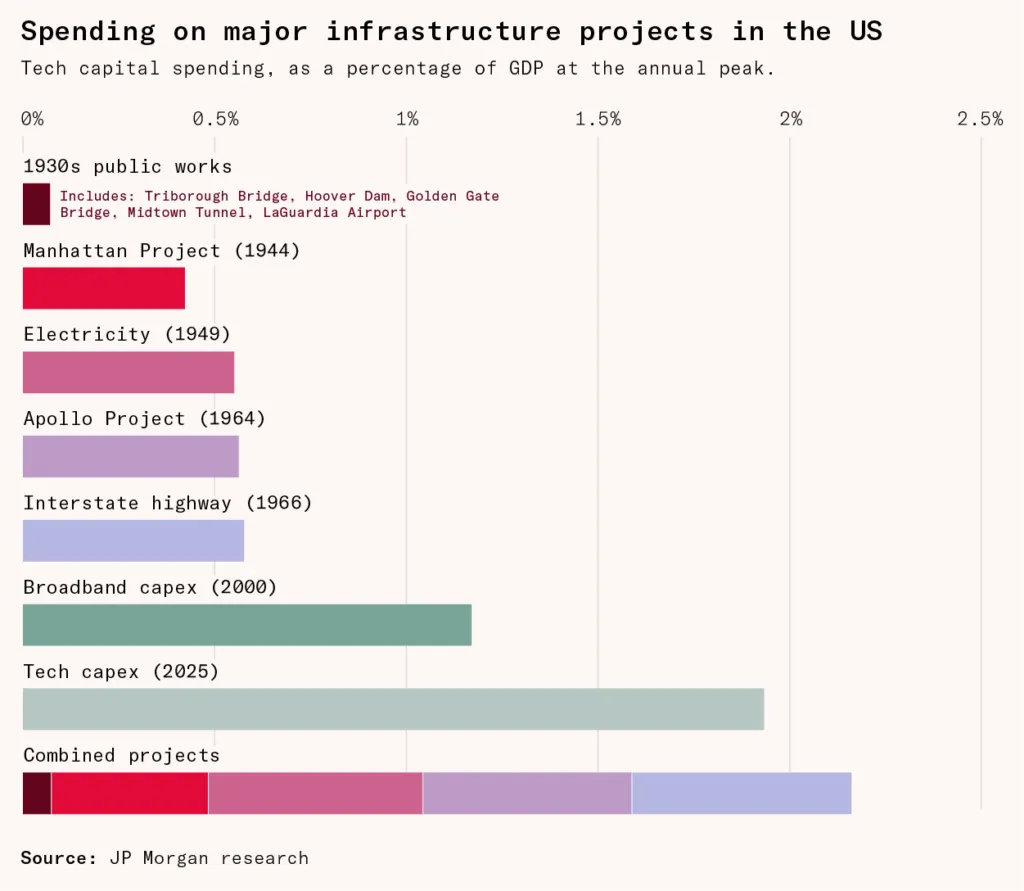
I wonder how public works funding would look if 90% of the nation wasn’t painfully far behind in maintenance.
But also, AI data centers have been around for like 3 years. It’s not surprising they haven’t reached a high level of efficiency yet.
IMO they are not an argument against excessive power use (I know this is not your argument, just a common one), but rather and argument FOR better (read: nuclear) power generation.
From the headline:
>the problem is getting it where it's needed.
Same issue with EV rollout. EVs are great if you have a single family home and a few grand to spend on outfitting a fast charger. Most apartment renters however are shit out of luck. I mean it has been how many years now of EV cars on the road and virtually no sweeping buildout of EV chargers in apartment complexes that I can see at least. There was a push for like maybe a half dozen token ev charging spots in new parking garage construction but that has been it for years in terms of that scale, a sort of nicety not something you can bank on having when you go to one of these garages. Street parking EV hookup has also not been rolling out at any serious scale. There is 1 single ev street parking spot in my neighborhood; they put it in years ago and nothing more has been built since.
I know someone with an EV in an apartment without a hookup for them, and charging it is a legitimate constant chore as they have to plan to go somewhere offsite to do it. Frequently they can't take the EV and have to resort to the gas car because the EV is at 20% charge or something.
I think what we are seeing with EVs is akin to general K shaped economy phenomenon. The rich and rich government leadership assume rollout must be going well, since they can charge conveniently at their house and they see many other Teslas in the parking lot of the country club or the luxury shopping center. Never mind actually considering how a renter's experience might be different, and renters are the bulk of our cities.
There's definitely a gulf between living-situations, and people assuming their local experience is nationally representative.
I had a car-purchase decision a few years ago, and ultimately I had to choose based on the housing I had, not the housing I wish I had. It was frustrating to hear a lot of "you can just X" from folks who couldn't seem to imagine an apartment or chaotic street-parking.
At least in California it is felt really among people who have private power providers that need to both turn a profit and appease shareholders while also paying out various lawsuits and penalties from causing wildfires with poorly maintained equipment. Compare those rates to what you'd get under a municipal power company like LADWP and the difference is dramatic.
It doesn’t really matter if, at the end of the day, our current usage is too high and consumers see EVs as a pro-social purchase. I don’t really think they’re a problem, personally, but it IS the topic of this comment thread, so it’s an appropriate place to complain about this particular issue.
Edit: also, the problem with charging vehicles isn’t really home owner cars, it’s tractor-trailers.
The idea is to bring the data centers, power generators and energy supply together in the ~same physical space so the only thing you have to transmit is data. Moving energy is way more expensive than moving information.
Are you really saying that in 2026, a year when only the nuts are still trying to claim climate change isn’t a thing, the most intelligent approach to the problem of powering data centres that are mostly being built for the purpose of juicing share prices is gas turbines at an industrial scale? The most intelligent approach is to not build the things. The next most intelligent approach is solar and batteries nearby. Way down the bottom of the list is burning gas to power them.
I don’t see how that generates anywhere near enough power, think about the potential energy of a bucket of water going up and down that amount over the course of a day.
Both are questionable. Tidal power is super neat in theory but we really struggle to make it viable in practice. GPUs in space are probably the lower risk option, but with even more questionable economics
My preferred outlandish idea would be to put the data centers next to solar farms in the Sahara. I just don't know yet how we are going to make the batteries to power that through the night
Question for the experts: does the power crunch mean that AI hyperscalers will turn off previous generation GPU datacenters to free up power for their new Vera Rubin GPUs?
The primary bottleneck to this growth is the availability of electricity.
The bottleneck for building some AI datacentres and switching them on is electricity, sure, but that's not what drives growth. There also needs to be demand for the additional capacity; people need to be waiting for capacity to catch up so they can do the useful work that grows [society|GDP|something] that they aren't doing right now.
There's also very likely to be diminishing returns from additional capacity if we're near or over the limit of productive use. And there's the opportunity cost of what could have been done with that [money|land|electricity].
This is a much more complicated system than "people say they need more AI -> build datacenter -> power datacenter -> magical growth!"
In the Innovation Adoption Curve, we are absolutely beyond the Early Adopters phase and possibly the Early Majority. The growth rates necessarily have to start trending down because there’s no one left to sell to.
I'm not sure if the classic adoption curve applies. Has there ever been a product that vendors were shoving down customer's throats as relentlessly as AI?
I don't think Anthropic are doing that because they don't have enough compute capacity. If we had 100* more datacentres the message would still be the same - they're focusing on selling Fable access to enterprise users because that's what makes them more money.
Either the cost to serve this larger model is so high that they cannot offer any reasonable usage quota for it at subscription prices, or they really do not have the capacity.
I think that it might well be true. The Opus models had capacity issues on many occasions too. Can the larger model even be served on all of the hardware they have, or only a subset?
It would not surprise me if growing enterprise demand threatens capacity, making it impossible for Anthropic to offer the model in subscriptions at this time, even though they could do so at a profit.
We do not know whether subscription plans are unprofitable at all.
Some estimates suggest that this is the case only for the heaviest users.
Many seem to confuse API prices with the actual cost to serve the models, and thus reach the conclusion that subscriptions must be deeply unprofitable.
Anthropic is officially citing capacity constraints with the intent to bring the Fable model back to subscriptions plans as soon as capacity allows.
> We do not know whether subscription plans are unprofitable at all.
That's pretty much certain. It's sort of cute when people like to pretend otherwise.
> Many seem to confuse API prices with the actual cost to serve the models, and thus reach the conclusion that subscriptions must be deeply unprofitable.
I don't make that mistake. I actually suspect that the actual costs may be higher than the API prices. I think those may still be subsidized.
> Anthropic is officially citing capacity constraints with the intent to bring the Fable model back to subscriptions plans as soon as capacity allows.
Yeah, I don't think they are being truthful at all.
"Discussions about expanding electricity supply to power the future often become debates about which source is most suitable: gas, nuclear, solar, or something else. But these are a distraction. Far more fundamental is ensuring power can be efficiently delivered where needed."
This is the reason why data centers are not run only on cheap solar power.
TFA isn’t about consumer usage, it is about training the next generation models. An interesting thought I heard recently is that a SOTA model has about the same parameters as the number of synapses in a Golden Retriever’s brain that are not dedicated to biological processes like breathing. Most of that should be wrapped in double quotes, don’t take it literally! But that number is about 100x lower than the same synapses in a human brain.
If the next order of magnitude costs 40B, I wonder if it’s even possible to get to the one after.
just wait. the current gold rush has left any consideration of efficiency or price-performance at the side of the road. the entire enterprise is structured as a 'whoever can spend the most money wins the game for all time'. if we can get past that and invest more in theory and systems at a natural pace it'll just keep getting more affordable over time.
The politicization of AI has been a huge damper. NYS put a 1 year moratorium on datacenters with some municipalities doing so as well. My town did a 1 year ban, despite us being a retarded location for a data center (more expensive land than surrounding areas, less water access, far from power). US has also been lagging in power capacity, because of the anti-growth segment of politics. More nukes.
You don’t even need to mention the long-term sustainability benefits of renewable energy. It is simply the dominant option economically. Dollars in, watts produced, fossil energy can’t touch it.
Politics is merely a downstream effect of the root of the problem: corruption and regulatory capture. Regression into the authoritarian petrostate pattern.
Who is opposing renewable energy? Texas is projected to top California as the state with the largest amount of solar before the end of the Trump administration.
If there was an oil refinery that looked exactly the same as a turbine from the outside, I would bet that he would love how those would look. The root cause is something else. Hmmm...
Totally agree. One thing the AI bros believe though is that growth == useful. If you strongly believe that the larger the model the smarter it is then you think through growth we get AGI which implicitly is useful because reasons.
This is part of why the AI bubble will burst. The only way to make the profit numbers backing the loans to AI companies is to get increased capacity, and the capacity requires energy, and the energy won't arrive in time, only partly due to all the factors here, and partly because building transmission and generation is speculative and can fail for a number of reasons.
US administration can try to pull a China and basically remove all regulatory barriers (following existing playbook of "do whatever we want and wait a year or two for the courts to catch up and stop us"). It'll create havoc that will make people very upset (more so than the people that already protest DCs in their backyards). But even then, it's construction on varied terrain and property over long distances; you can't predict exactly how that will go. Triple the estimated timeline and that is probably doable, but current AI investment likely can't wait that long, unless somebody can pull additional hundreds of billions out of a hat to extend lines of credit or a ponzi-scheme-esque paying-creditors-with-newly-lent-money. In that time the market will realize the hype was hype, the gains were modest, they'll start divesting, and then the house comes down.
One way around that might be to deploy thousands more gas turbines and make rural air quality look like 2010 Beijing. It will probably happen if things get really tight, and we'll see how the current administrations's base responds; if they stick it out, the market gets a reprieve.
This almost reads as satire from something like The Onion. What on earth does "Hollywood and their woke agenda" have to do with how AI data centers are powered?
We should have been building more nuclear. We’re not going to upgrade civilization with windmills and putting on sweaters. Think of how much power we’ll need for millions of robots?
Unit economics for renewables coupled with storage are excellent. I agree we should reform nuclear regulation to allow new nuclear plants to pencil out. I disagree that we should discount the value of renewables.
Solar and wind take up a bunch of space and generate a bunch of waste after the panels are decommissioned, plus the wind generators are ruining every single landscape we have. With 5 nuclear stations per country you could cleanup so much of Europe.
The environmental damage caused by "clean" power sources is done mostly in countries which are far from Europe, so it's not much discussed in Europe.
Like:
Copper. "As the world shifts to wind energy and electric cars, demand for the conductive metal has increased. But mining copper brings its own environmental hazards"
They probably are aware of nuclear waste and of the modalities of dealing with it, and still believe that not investing into nuclear is shooting yourself in the foot.
FYI, a typical 1GW nuclear plant produces 30 tons, or 10m3, of high-level waste. Germany uses ~500TWh of electricity per year. So Germany could replace all their electricity generation with 60 nuclear plants and would need to find space for 1800 tons or 5km3 of waste per year.
For comparison, German landfills can accommodate 70M metric tons per year.
France, a country famous for its investment into nuclear, is not covered in nuclear waste, and does not seem to have any issue disposing of it safely.
Nuclear has its disadvantages, but painting the many people who advocate for it on HN as delusional or ignorant is not very respectful.
How many tons does it take to make a dirty bomb that irradiates a city center or small downtown? To poison an aquifer when storage fails? How much does it cost to make sure neither of these events, or any other similar hypothetical, doesn't happen, not even once?
Solar doesn’t produce that much waste either and that was the point. Just because you don’t see the nuclear waste doesn’t mean it isn’t sitting there somewhere. The person was acting as if clean energy is dirty via its waste. For the record I’m all for nuclear - it’s insane we’ve regressed so much and not invested into more. But it’s also insane we’re not taking more advantage of green energy where we can.
Most of the solar panels are pretty non-dangerous waste (cadmium telluride (CdTe) solar panels are dangerous waste, but are currently only small part of installed solar panels).
Silicon tetrachloride used for silicon production is toxic and has to handled carefully.
The main point is that, if Europe wants to invest more in solar power, it should also do the manufacturing in Europe and waste disposal in Europe.
Sure, I don't disagree with the ideal of onshoring more manufacturing for solar, but then the same standard should be applied to the entire supply chain of all forms of power generation. Frequently those negative externalities seem to be most often raised as a "gotcha" for solar specifically, in an attempt to rebut the clear environmental advantages.
For example, nuclear power is often sold as a plant that just sits there churning out zero-emissions power for 50 years from a few tons of super energy dense fuel (such as from the above commenter). Without acknowledging that fuel needs to be enriched from intensive and environmentally destructive mining of raw uranium ore. Which comes with risks to workers and possible contamination of groundwater to nearby communities, etc. Or the carbon impacts of the massive amounts of concrete/steel/etc that are required to build the plant, or the opportunity costs of spending tens of billions on a plant that will require continuing to burn natural gas and coal for another 10-20+ years until it comes online as a replacement, etc.
Otherwise it's just special pleading to apply a different standard that exaggerates the negative externalities of solar + batteries.
It's been regulated "to death" because it's responsible for some of the worst man-made catastrophes of all time and has made large swaths of land uninhabitable for ~forever.
It really hasn't though. Fossil fuels kill or disable more people every year than nuclear power has, ever.
Even in terms of radiation accidents, nuclear power generation pales in comparison to orphan sources from medical equipment. Yet you don't see people clamoring on about fewer x-ray or radiological machines.
> made large swaths of land uninhabitable for ~forever.
Are you talking about places besides the Chernobyl exclusion zone?
And why compare the small amount of area made dangerous by nuclear accidents to the entire planet being destroyed by fossil fuels?
Cheap ubiquitous distributed power systems will change the world in many weird ways. Watch small modular nuclear offer home installation for ~$reasonable and getting cheaper every year.
Fast forward 20 years from the advent of essentially infinite energy results in WWIII and a new “Great Detente” but only after all the assholes have wreaked all the havoc they can.
There are dark days ahead but ultimately a brighter future. Sucks to live through that transition phase though.
I'd like to see a well reasoned plan to install small modular nuclear power at peoples houses that prevents the mentally ill, criminally reckless or terrorist minded people from cracking them open and obtaining access to the isotopes.
From a strictly red team threat analysis perspective, if you have an extremely safe working reactor that can't be made to melt down, no, the reactor can't be used to hurt much that is in the same location as the reactor. If you are able to get the isotopes out and start spreading them around or making a dirty bomb type thing (where the explosion just serves the purpose of throwing the isotopes around), that could be pretty catastrophic.
have you never visited a rural neighborhood? or an affluent neighborhood?
there are still many neighborhoods where people leave their doors unlocked because it is actually that safe. not every location is rife with criminal activity, and many are well protected.
Serious question, do you actually think that if you distribute millions of small nuclear reactors to homeowners geographically spread out around all of North America, 0.000% of them will be dangerously mentally ill, criminally reckless or inclined to terrorist like activity? Based on the frequency and number of mass shooter type incidents, (or like, David Koresh and the Branch Davidians) this would be a very naive view.
It doesn't require a criminally minded 3rd party coming onto someone's "safe" property to do something horrible with a sawzall and/or oxy-acetylene cutting torch.
That's a very optimistic view of humanity that I can't say I share. If you give a sufficiently motivated person enough isolation and time, they can cut into just about anything. And possibly deal with cleaning up the results of any internal tamperproof countermeasures. In a world that contains people like the Las Vegas mass shooter or those who conducted the 2015 attacks in Paris, handing out isotopes to the ordinary person seems like a recipe for disaster.
We live in a world where multiple people are killed every year by tipping vending machines over onto themselves and you propose to make nuclear reactors a mass market consumer good that goes in everyone's garage?
First: microwaves are only safe if you don't mess with them, a bunch of people get killed by tinkering with their high-voltage transformers (at least 35 US deaths from one specific usecase alone in the last decade, see https://www.woodturner.org/Woodturner/Resources/Safety-Mater...).
A big potential concern with small reactors are highly toxic radionuclides; those can be much more dangerous (with LD50 far under 1mg/kg) than "ordinary toxins" like bleach or even nasty stuff like methyl isocyanate. That means expensive disposal and protection measures.
All of this is a non-concern though because there is no realistic path for nuclear reactors to compete with PV+batteries, ever. With cells already <$100/kWh and the panels being cheaper than glass windows, we will never be able to build, maintain and dispose of nuclear based reactors tech at a competitive price point, especially not with the insane current battery demand (automotive) driving technical optimisation and price competition.
> The worst thing an evildoer can do is blow up your own house and the few around it.
No, they can take the isotopes out and dump it into your local water supply. Or if they're suicidal and the isotopes have been encapsulated in some sort of tamperproof system, grid the whole thing down to granulated powder using less than $20,000 of power tools (disregarding their own health and the entire nearby area, of course) and then dump it into the local water supply.
If someone evil has access to the water supply, is radioactive material the worst they could do? that'll, what, give some people cancer which is really bad but it'll take a while to get them. If people wanted to be shitheads, they could already dump arsenic or LSD into the water supply, or any number of others things. that are already available to them right now! Have you personally tested your taps chlorine or flouride or lead levels recently?
You're seriously proposing that a country with regular mass-shootings should give everyone a device that can cause a radioactive meltdown or a small explosion?
We already let people have cars and those things are crazy dangerous! No one should be allowed anything, ever, until we bubble wrap everything in the world to be perfectly safe!
Well, we already have strict background checks, licensing and regulations for a scenario such as if a person wants start a home based business manufacturing and storing C4, Semtex or similar at their rural property. If the idea is to start handing out nuclear reactors for peoples' houses, the possible damage that could be done is far greater. No matter how well packaged it is or designed to be consumer friendly.
There were some crazy ideas for nuclear powered cars, but there are hard physical limits how small you can make a nuclear reactor.
1. Smaller the nuclear reactor is more neutron leakage you get. Each neutron which escapes a nuclear reactor is a neutron which can not be used to sustain the chain reactor. To compensate this you have to put more fissionable U-235 isotope into the reactor and as a result you need higher enriched nuclear fuel. A nuclear reactor in nuclear submarine can have the size of a dining table but it's running on nuclear fuel enriched to a weapon grade enrichment.
2. Even a small nuclear reactor with few kW thermal output needs a thick and heavy radiation shielding. This is not problem for power plant, or nuclear powered submarine, or nuclear powered ship. But the shielding requirement were problem for nuclear powered airplanes or trains.
In case of the mobile ML-1 experimental nuclear reactor, built as part of the US Army Nuclear Power Program, extensive shielding was omitted in favor of a personnel exclusion zone of 500 feet (150 m) while in operation.
Chicago Pile-1 (CP-1), the first artificial nuclear reactor, didn't have shielding. But, to keep the dose of ionizing radiation for the staff within reasonable limits, it operated only for very short time periods and the total output of CP-1 was only few Watts.