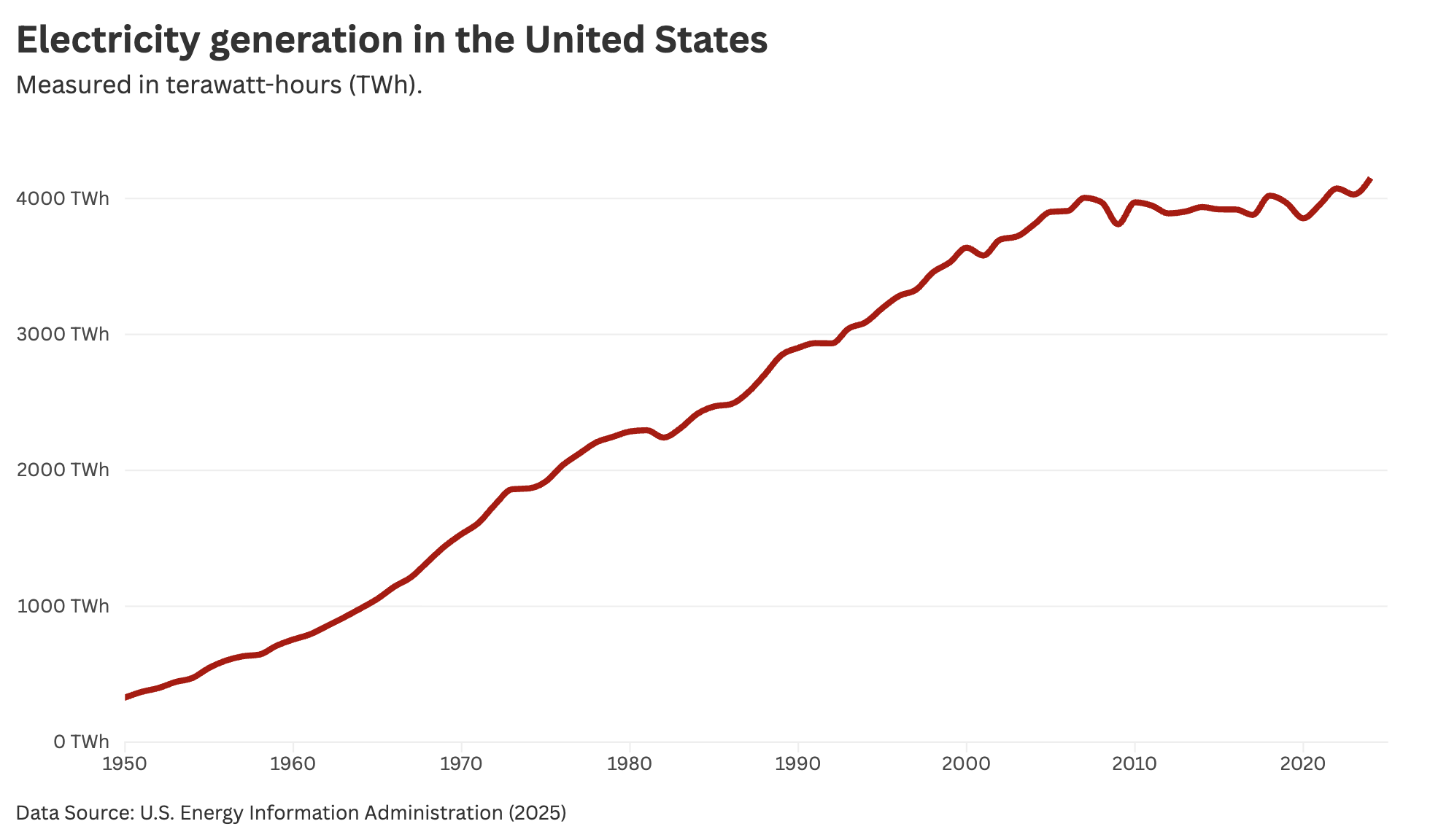
Lawrence Berkeley National Lab recently did an analysis on electricity prices in the US [1] and found that most of the rate increase in Virginia was attributable to the VCEA, and that load growth had a mitigating effect on price increases.
If you look at the overall report (not just Virginia), the places where electricty costs are rising the fastest are generally not the same places where lots of new datacenters are being built. It's easy to blame datacenters, but there are many factors at play here.
[1] https://emp.lbl.gov/publications/factors-influencing-recent-...
In other words, large “base loads” like data centers could both reduce the average power bill AND contribute to capacity shortages and load shedding.
They often have an individual contract with the utility and participate in load regulation: when you need liquefy a few tons of steel, those heaters have a lot of thermal inertia. If A/C loads are high they'll turn the power down, if wind output is high, they'll turn it up, and so on.
Do data centers participate in the same sort of dynamic pricing and power adjustment? I understand that they're spinning up and powering down instances on demand, and that those demands are somewhat outside of their control, but are they able (and willing, and desirous of reducing their electric bills) to dynamically adjust compute in response to utility rates?
There is not a good picture in aggregate though so it creates all kinds of narratives.
They are mad that they aren't getting special treatment. They want to be treated better than the aluminum smelting plant.
Henrico County currently has 37 data-centres with ~2 gigawatts capacity (expected to reach 3 gigawatts).
Apparently, 1 MW can power approximately 834 homes annually. So 2 gigawatts would be closer to powering > 1.6 million homes.
Surely, that kind of concentrated demand is going to affect electricity distribution costs for everyone, which is what we are seeing now.
It's so strange to me that the argument previously was "we don't have enough energy generation for EVs and heat pumps to electrify and decarbon" but data centers are thought of as must run load that everyone has to suffer in some way to enable (through increased rates or risk of blackouts), when they have very little positive impact for everyone except a small minority investing in them.
> It's easy to blame datacenters, but there are a lot of factors at play here.
It is because they are the problem. We need as much clean energy as quickly as possible to mitigate climate change, we do not need data centers, broadly speaking.
(if you replaced all of the farmland/ag land, the size of the state of Oregon, harvested for ethanol with solar, you would have more electrical generation than all current US electrical generation combined as of this comment; this is simply a question of will, proven by China's solar PV deployment rates [installing ~90-100GW of solar PV per month])
That seems slightly weird, but that sounds like there's some large fixed costs that they can spread over the entire subscriber base, so the extra data centers are picking up some of those fixed costs.
TLDR Humans need electricity to live, data center loads are a luxury that can wait for power to be provided, when available.
People have also deployed lots of solar to their houses.
So by every normal measure, just by looking around outside and evaluating how I live my life, even with an electric car, my power demands have gone way down.
So the fact that there's some gooner class stroking AI and crypto coins out their network ports and making my electricity more expensive, well, yeah, I'd say that nonsense is lots of externalities that should be better managed.
The de-industrializing of the US is a much larger reason we have been able to use cheap parlor tricks vs. actually building things for the past 40ish years.
Those cheap tricks are now running out of easy gains, and the chickens are coming home to roost. At some point you run out of your grandfathers investment into future society and basic infrastructure.
To anyone paying attention to it, this problem has been a slow moving disaster for decades. It’s effectively impossible to build net new generation or large scale transmission upgrades on any reasonable timeframe or budget. Even getting a wind farm in the south end of my state interconnected to the load center metro area in the central part of the state has been over a decade so far and no ground actually broken. Just constant NIMBY.
We have gotten lucky and lazy for the past few decades.
Gartner Says Data Center Electricity Consumption to Grow 26% in 2026 - https://news.ycombinator.com/item?id=48665985 - June 2026
Nobody Here Wants the Data Center: An Oral History - https://news.ycombinator.com/item?id=48662607 - June 2026
Europe must choose between AI and climate goals, data center lobby says - https://news.ycombinator.com/item?id=48637512 - June 2026
Datacenter boom keeps dirty coal plants alive in the US - https://news.ycombinator.com/item?id=48465092 - June 2026
Majority of US’s new AI datacenters to be built on drought-hit land - https://news.ycombinator.com/item?id=48447122 - June 2026
A Farmer Donated Land to Turn into a Park. The City Is Building a Massive Data Center Instead - https://news.ycombinator.com/item?id=48446439 - June 2026
Data Center Operators Are Trying to Fix Their Water Use Problems - https://news.ycombinator.com/item?id=48401477 - June 2026
The US is now spending more on data center construction than on public transportation infrastructure - https://news.ycombinator.com/item?id=48366144 - June 2026
Ohio hits pause on datacenter tax breaks draining its coffers - https://news.ycombinator.com/item?id=48361555 - June 2026
Tracking at:
The article says
>Goldman Sachs economists forecast that data centers will account for nearly half of U.S. growth in power demand through 2030. As a result, they saw consumer electricity prices rising about 6% annually this year and next.
but it also cautions
>Even electricity accounts for only about 2.5% of consumer spending, according to the Labor Department.
Electricity has gotten more expensive, it's only growing twice as fast. It's also unclear how much of that it's due to AI, as goldman sacs claims. For instance, if you look at the BLS figures for electricity prices, it shows a huge in 2021-2022, well before the datacenter boom started. Others have mentioned rates are going up due to modernization efforts and/or the switch to renewables.
I wish there was more science driven reports based on what’s really happening. So much of it seems to be spun into people’s emotions that’s it’s hard to make sense of it. The public energy companies like to blame data centers but then data in certain geographies suggest otherwise. There was a good semi analysis months ago on how pricing I believe in New England was less about data centers and more on how inefficient the forward auction was constructed for prices there.
‘Cost Me the Election’: Data Centers Trigger Voter Backlash - https://www.newsweek.com/cost-me-the-election-data-centers-t... - June 25th, 2026
Utah Senate President Loses Primary After Data Center Backlash - https://www.nytimes.com/2026/06/24/us/j-stuart-adams-utah-se... | https://archive.ph/MMot6 - June 24th, 2026
Where Republicans and Democrats stand on AI data centers - https://www.ipsos.com/en-us/where-republicans-and-democrats-... - June 12th, 2026
Americans Oppose AI Data Centers in Their Area - https://news.ycombinator.com/item?id=48183512 - May 2026
I believe the data shows data centers to have an outsized impact on the costs discussed. Others may disagree, but the facts are the facts, especially if we're asking schools to conserve power while serving data center loads (per this post and related thread). That is not a fact in support of "data center power consumption is not of material concern, and does not require potential regulatory intervention." Quote the opposite (again, imho). If data centers do not have enough power, the solution is simple; force them to load shed and operate dynamically based on the remaining power available to them until more power is brought online.
Just because you want to believe it does not make it true. You are claiming it’s 100% the reason and I am suggesting it’s probably part of it but unclear if it’s 5% or 90%.
Not only that, but states with increasing electricity consumption have lower rates. So it's possible data center will lead to lower rates.
> IER is a member of the advisory board of Project 2025, a collection of conservative and right-wing policy proposals from the Heritage Foundation to reshape the United States federal government and consolidate executive power should the Republican nominee win the 2024 presidential election. The Institute's CEO and founder, Robert L. Bradley Jr., is a senior fellow at the American Institute for Economic Research and Energy & Climate Change Fellow at the Institute of Economic Affairs in London. He has written eight books, including Energy: The Master Resource; Climate Alarmism Reconsidered; and Edison to Enron.
https://mediabiasfactcheck.com/institute-for-energy-research...
> Overall, we rate the Institute for Energy Research as Right Biased due to its strong advocacy for fossil fuel expansion and deregulation, aligning with free-market conservative energy policies. We rate its reporting as Mixed for factual accuracy, as it does not always align with the consensus of science by selectively presenting data that favors fossil fuels while downplaying or omitting information on climate change and renewable energy viability. IER is a nonprofit organization that does not fully disclose its funding sources. However, past reports indicate financial ties to fossil fuel interests, including donations from ExxonMobil and groups associated with Charles Koch—a key funder of climate-skeptical and free-market advocacy. While the institute claims to support “energy freedom,” its funding sources suggest a strong alignment with the fossil fuel industry.
Data Center Power Demands Are Contributing to Higher Energy Bills - https://www.eesi.org/articles/view/data-center-power-demands... - February 26th, 2026 ("As data centers expand nationwide, utilities are receiving hundreds of gigawatts in interconnection requests, with implications for the power grid and consumers. Dozens of utilities received data center requests for at least 700 gigawatts (GW) of power connection development in 2025, which is more than the 477 GW in electricity that the United States consumed in all of 2023. Even though many of these projects will never be built, the requests are still leading to a ramp-up in energy infrastructure investments, including generation facilities, transmission lines, and transformers.")
No more PJM data centers unless they can be reliably served: market monitor - https://www.utilitydive.com/news/pjm-data-center-interconnec... - November 26th, 2025 ("The PJM Interconnection’s market monitor urged the Federal Energy Regulatory Commission to rule that large data centers can only come online if the grid operator can still meet reliability metrics.")
FERC Complaint: https://elibrary.ferc.gov/eLibrary/filelist?accession_number... ("20251125-5275_2025-11-25 IMM Complaint re Data Center Loads-AS FILED-1.pdf")
Brannon, Ike and Wolf, Samuel, The Impact of Data Centers on Energy Demand and Market Prices (November 11, 2024). Available at SSRN: https://ssrn.com/abstract=5017484 or https://doi.org/10.2139/ssrn.5017484
> The number of data centers in the U.S. has increased sharply in the last decade and nearly all forecasts suggest that their growth will accelerate in the next decade, mainly driven by the rapid adoption of AI. Since data centers are extremely energy intensive, they have led to significant increases in energy consumption. After two decades of relatively static demand, demand for energy in the U.S. is accelerating rapidly, and demand growth is driven in large part by data centers.
> Data centers have had a particularly strong impact on Northern Virginia: More than half of all the nation's energy consumption attributed to data centers occurs in the state-mostly in Northern Virginia, where the needs of the federal government and national security agencies are important drivers of demand.
> Capacity market prices in the last auction nearly doubled across the PJM region and by more than 14 times in Virginia, signaling an urgent need to secure new transmission and generation to ensure reliability for consumers. Billions of dollars of new investment in generation and transmission capacity will be needed to restore a healthy reserve margin and to recover the portion of reserve capacity that has been consumed by data centers.
> We estimate that failing to make such investments in a timely manner would force regulators to acquiesce to rate increases of as much as 70 percent in the next decade in order to ensure that the grid functions properly and provides energy to all users. The consequences of such a failure could be the appearance of regular brownouts and blackouts in Northern Virginia and across the country.
(If you want to talk to someone at Brookings, FERC, UtilityDive, or another domain specific firm to confirm, let me know and I will connect you to them)
Brookings misses out on of the key failures in PJM which is how those terrible 3 year forecasts are causing issues with rates.
Again interesting from a policy perspective but they don’t reach your claim of data centers being the entire problem for retail energy rates.
Do you think that distribution infrastructure required would be free? Do you think markets respond to new demand with new supply instantly?
The market incentive to increase generation is higher prices.
Data center investments, in terms of the energy they will require, far outstrip generation planning and buildout, and by a huge margin.
When you have a demand/supply equilibrium, and you drastically increase demand, what happens to the price?
Perhaps we should charge AI subscription "tax" to pay for more renewable energy.
February: https://www.roanokerambler.com/water-authority-releases-goog...
April: https://cardinalnews.org/2026/04/14/former-roanoke-rambler-o...
This tells me they know what they're doing is unpopular and are willing to squash any opposition.
My machine had a hard reboot that first night... I lost my unsaved work and at that point I made it a point of religiously saving my work each evening when I went home... because each night my machine rebooted.
One day it was rather quiet. Might have been day before a long weekend, but it was a slow day in the building - very few people were walking about. I was working... and then my machine lost power. I stood up to figure out what was going on and my machine got power back. Ok... followed power cords to the wall. It was plugged into a gray outlet (rather than white outlet). The gray outlets were hooked up to the motion sensor that was for the hall lighting.
Motion controlled lights are always timed badly, incredibly annoying to have them switch off when you are sitting still working or taking a duece.
How about the janitor shuts off the lights after everyone goes home?
I say that to make a point about magnitude of annoyances. Sure it’s annoying. So are potholes.
It does seem like a slightly smarter device could be built. The times it happens to me, and I wave my hands in the air to turn lights back on, it’s not that annoying. When I’m there for 3 more hours and I have to do it every 5-10 minutes. That’s more annoying. So the simple thing to do is to program the thing to incrementally increase its timer length. 5/10/20/30 minutes might be less annoying. Also if motion is detected a short time after the no motion timer triggers, that’s probably a sign there was someone present the entire time. Can adjust the logic with that in mind too. The current devices are fine it’s the logic that was lazy.
“Everyone turned off their lights” relates to power.
“Power datacenters for one second” relates to energy.
“Power spent on lighting worstations while vacant” is energy
I claim that's 75W of power that could be reclaimed by turning off a 100W load 75% of the time. Explain how you get to energy or how I dropped time, please.
Without some sort of mitigation, the costs keep rising and it'll drive families away from these cities and/or counties to avoid the cost hikes. This is akin to what we're seeing in a lot of major cities with rent, people are living further and further away from where they work, paying taxes in other forms (time, public transport costs, gas costs for their car inc. wear & tear, etc).
Hardly seems fair or right.
This is literally what they believe in. This is what they have been doing for nearly 50 years. It's the entire purpose of neoliberalism: corporations are more important than citizens.
Part of solving that may be in what the article touches on - how to get the generation built before the DC shows up rather than as a promise after.
I appreciate 404 media's mission but isn't there enough stupid shit existing naturally in the world for them to illuminate that we don't need to do this?
So the best way to keep money coming in is to read the vibes of social media, and print stories that fuel those fires. Basically manufacture stories using well established marketing and propaganda techniques to maximize click rates.
Ice cream man selling ice pops in the park becomes "Man seen using treats to lure young children to his van in the park".
Honest headline, criminally misleading takeaway.
Like 37 data centres in a small rural county?
The whole thing seems pretty overblown: County where energy prices are up 25% sends a memo asking employees to conserve electricity doesn't seem worth writing about. If prices are up 25%, I bet the datacenter guys are also working on efficiency. The county isn't asking datacenter peeps to conserve energy, because the county isn't paying their electricity bill.
From the headline, I thought this was going to be schools that signed up to participate in demand response in return for reduced electric rates are being asked to reduce their demand. Growing up in socal, most of the schools were on demand response programs, and sometimes we'd have reduced lighting as a result. I wouldn't expect a lot of datacenters to participate in demand response programs, so the angle would be 'the schools have to turn off their lights, but the datacenters don't do anything' ... ignoring the cost savings the schools signed up for; some datacenters could participate though --- large operators can move traffic and shutdown, idle or limit power for most of the servers, or can switch to local generation; but facilities for small hosting / colocation probably don't have enough insight into their customer loads to move traffic and might not want to run their generators.
Some of the data centers now run disconnected on gas turbines 24/7, which is better for electricity prices but they can be big nuisance for people living nearby.
It is a near certainty that power rates would be cheaper for these cities if they removed themselves from the PG&E pool. Right now they look to be on the hook to help pay for all of the (long deferred) power line under-grounding that the recent state wildfires have proven is necessary. Much of that under-grounding is to get power into remote locations, and does nothing for most people (other than the implicit reduction of wildfires, which is a complicated subject).
But there is a second side to that coin: without the big cities full of people (which are relatively cheap to service), all of the needed under grounding costs are going to fall to rural California areas, and they simply don't have the population or finances to pay for that.
Personally I am in favor of some mixture. I would make the utilities all completely non-profit, with no investors to demand returns (the current system has perverse incentives). I would also start looking at some drastic limitations on where the public pays for power lines. Yes that would make some rural locations financial impossible to draw power to, but that would probably be a part of a real-plolitik re-evaluation of where people can afford to live. This is probably going to line up pretty closely with pushing people out of fire-prone places that should also be pretty much un-insurable anyways.
The list they give is overwhelmingly dominated by one item:
“Turn off your lights when leaving your workspace, including when you leave for the day. Turn off your computers/laptops at the end of each workday. If your workspace has windows, adjust the blinds to manage heat from sunlight. Unplug any appliances, chargers, or other electrical items when they are not in use. Please limit use of (or refrain altogether from using) space heaters. A typical space heater alone can cost the county from $150 to $300 per year in electricity costs.”
$20 of AI tokens over a month? Probably somewhere between, on average, 40-320 W, depending on how you weight the cost of training and which recent-ish model you're using.
Tokenmaxxers? They're the heavy users. $2k/month (or whatever) gets you a lot of electricity through those GPUs.
obviously the average goes up in this circumstance...
but sure would be nice if it would cause an exponential acceleration of fusion development in the meanwhile
however that still has a law of theromodynamics problem of pumping heat into atmosphere
maybe exponential advancement of solar but they've already figured out that cannot improve more than another several percent, and manufacturing is already near peak efficiency
The AI bubble can’t pop soon enough.
1) https://www.404media.co/the-tokenpocalypse-is-here-companies...