The paper opens with "to feed a growing population" without asking is that what we need? want? where we are actually heading to?
Is feeding the world a real problem? I've yet to see compelling evidence that it really is except as a secondary effect of logistics, energy supply, and war.
edit: I understand the environmental impacts. I think we should solve our energy problems first.
Yes, but it is not a production capacity problem. The constraints on food are mostly in the logistics chain, often having to do with corruption or distribution targets (food goes where the money is), or regulation (did you know that cherry growers in the Upper Midwest are required --_by Federal law_-- to destroy unsold crops?).
A huge amount of food goes to waste simply because of regulation or subsidies, at least within the United States.
Tart cherries are supply-controlled because they are processed into other goods, like pie filling, and can be stored for long duration (multiple seasons). The supply-control regulation is designed to prevent a surplus crop from depressing the market to the point where it's no longer viable to grow tart cherries - reducing future supply, ie. the regulation is designed to provide a consistent, stable supply.
Surplus tart cherry crops are rarely destroyed. In the event of a surplus, they are often exported, diverted to secondary markets, donated, or carried-over into next-season's stock.
Yup. The regulations on food in the US is exactly to make sure the shelves stay stocked no matter what. Without such regulations, you'd experience random items being unavailable and price shocks.
One thing people often don't figure or realize is food takes time to grow. It requires long term thinking to make sure supplies are sufficient. Left to their own devices, farmers will often chase after last season's cash crop. That is bad. It's far better for farmers to stick to more predictable growing and for more dedicated incentives to be issued.
Did you intend to be so insulting, condescending, and dismissive? "Left to their own devices, farmers will often chase after last season's cash crop. That is bad. It's far better for farmers to stick to more predictable growing and for more dedicated incentives to be issued."
I think your fun cherry fact is pretty inaccurate. If you're referring to USDA Marketing Order #930, it's basically about setting sales limits in bumper crop years to avoid a situation where so many cherries hit the market that farmers lose money simply by harvesting them. They're free to donate the cherries etc. but again, they would be essentially wasting their own money by putting in the time and effort to harvest them beyond the amount they're allowed to sell.
This is for good reason though. You want to overproduce significantly in ordinary times so that if there is a big negative shock you will still be able to produce enough to feed everyone merely by not destroying the excess anymore.
But in a pure market that would mean that during overproduction times, prices should be low. Which they artificially aren't through industry price fixing.
The result that free markets are Prato optimal, though, requires conditions like low barriers to entry, perfect information, and low cost transactions… none of which seem very well met in the case of agriculture.
That's a nice bit of trivia but it doesn't really affect the comment you're replying to. It's still food, full of flavor and calories, and able to be used by a home cook (by making a pie).
If you researched this regulation even a little, you'd see the crops are rarely destroyed. They are far more often exported, diverted to secondary markets, donated, or carried-over into next-season's stock.
It's interesting to me how people are quick to comment about things they know nothing about...
> It's still food, full of flavor and calories
Tart cherries have about 1-2 calories per cherry, and do not taste good without a lot of sugar. That's why they are used in commercial processing, not generally sold as a fruit in grocery stores.
So you understood the crop we're discussing is rarely destroyed - and more often donated, diverted to secondary markets (ie. sold in grocery stores), or exported - yet still felt compelled to say a home cook could use them?
What was even the point of your snarky comment then?
> So you understood the crop we're discussing is rarely destroyed - and more often donated, diverted to secondary markets (ie. sold in grocery stores), or exported - yet still felt compelled to say a home cook could use them?
In the context of someone talking about home cooks using them, and you acting like "People do not eat tart cherries directly." is a counterargument, yes I felt compelled to correct that.
The incorrect thing you were implying had nothing to do with how often they're actually destroyed. So why would that stop me?
People do not eat tart cherries directly. The overwhelming majority of people will never process them into something edible either.
"People in need" are not going to spend time and money processing tart cherries into juice concentrate or pie filling... especially when a can of either is cheaper than the raw ingredients to make your own.
Your point is ridiculous, absurd and pedantic beyond any reasonable purpose.
Most of what you are saying is correct, but I feel the need to respond to your far too many repeated assertions that "People do not eat tart cherries directly": Except for when they do!
I grow several varieties of sour cherries in my yard, and frequently use them whole and without further processing. Usually I use them in a recipe like this: https://en.wikipedia.org/wiki/Clafoutis. Sometimes I pit them first, sometimes I don't. Sometimes I'll even happily snack on them raw.
No, like most small fruit you aren't going eat them because you are desperate for calories. But they actually aren't any harder to prepare or use than lots of other tasty things that people traditionally grow.
I recommend you visiting the Brazilian region of Pantanal, if possible travel through Mato Grosso do Sul -> Mato Grosso -> southern Pará where it transitions into the Amazon.
You will see vast areas of cattle ranching, soybeans plantation used for cattle feed, and other crops that can be used as cattle feed. All that area used to be the Pantanal and Amazon, now transformed to grow beef.
If we would reduce the calories wasted on beef, this area could still have a lot more native vegetation. Of course, it's purely wishful thinking because this ship has sailed, beef consumption will take a long time to stop growing, these farms will fight for their lives to keep producing, and we've lost a huge area of incredible nature to eat some steaks and burgers.
It's the leading cause of deforestation which is a major factor in climate change. It also is a major contributor to climate change for other reasons. Since you mentioned energy, it's also much less energy efficient.
Solve our energy problems first? How would decreasing cattle stop work on improving our energy system? I think a lot points to that we need to do both (and yesterday). It’s not like agriculture is a small part of our greenhouse gas emissions (25-35% globally).
Exactly. The current world population is 8.3 billion and is expected to peak at 10.3 billion in 2080 and then begin declining. Now, there are a number of other reasons we might have food shortages, but population per se I don't think is a significant factor.
Even if food shortages aren't an issue, reducing the amount of land dedicated to food production is a win for ecosystems.
Not saying people have to go vegetarian, but reducing meat consumption or using more efficiently produced meats (in terms of land use) would overall make the world a nicer and more interesting place.
And, really, with the whole neu5gc thing, it might be that humans would be better off focusing on chickens and seafood anyway (clams being a pretty good option for seafood that is relatively environmentally friendly).
Grass fed cattle can use land that is generally not fit for vegetation farming... because of excess rocks, etc. Ruminants that are being naturally (grass) fed are also regenerative in terms of soil health.
They don't tend to "bulk up" as much as conventional (grain fed and/or finished) options though, so are more expensive to produce... the gas emissions are another issue that is largely different for grass fed, where the off gases are roughly the same as the grass's natural breakdown would release anyway.
In terms of water use, naturally grass fed cattle are mostly using water that fell on the land as rain in terms of how much water they use. It's not much from municipal sources, unlike vegetation farming.
Of course there are other ruminant options that are more efficient than cattle, such as goats and sheep, with similar benefits to the soil.
It just bugs me that cattle gets such a bad repuation... especially in that it's one of the few things I can eat without issue.
So, I was saying ecosystems. Filling the world with cows is not the same as natural ecosystems.
Also, kurzgesagt did a pretty good episode on meat production (edit - they did several, but one was on the production demands in terms of energy and environment), and if I'm to trust their figures, the "cattle grazing exclusively on the pampas" is far from the majority of world cattle. If it was, that probably would be an improvement, esp if it was done in a way that allowed other species to exist too (maybe bring some buffalo back?). The percentage would be dramatically improved if finishing lots were eliminated though (still a minority though). So maybe that's a simple option. Plus, that's the cruelest part of the cow's existence.
I don't think the answer is reduce though... I think it's increase... humans wiped out so many of the ruminant animals (buffalo mainly) that kept the grasslands healthy... we've largely over-farmed in the interim since. We need more ruminants, not less.
This means raising much more than we currently do, and probably a reduction in slaughter numbers for the next 50+ years to increase the domestic supply. Can't speak for other nations... but it's literally expanding grasslands as opposed to desert.
Yes. I saw that TED talk about desertification being reversed by ruminants, and while it got a lot of critics, it had some pretty good points. But, those ruminants would be better off not being beef cattle in terms of biodiversity. Also, if they were beef cattle due to the lack of anything better, hopefully it would be short term, and if you're making a case for use of marginal land, they really shouldn't be finished in a feed lot, since that is using a lot of cropland to support that.
... and only some places would (possibly) benefit from that.
I think cattle are fine... though I'm also okay with more Bison, goats, sheep, deer, elk, etc. I'm also more than okay with less use of feed lots and direct butchery of grass fed ruminants.
As for marginal land... personally, I can only handle mostly eating meat and eggs, doing much better with ruminants. I'd be just fine with the majority of uninhabited lands being used by mostly wild ruminants over any kind of farming, especially farming that is using chemical fertilizers and stripping the land.
> Grass fed cattle can use land that is generally not fit for vegetation farming
Can, but that doesn't mean it always is. There's lots of cattle that never even comes outside, and is fed food that humans could also eat.
I recall reading that during the famine in Ethiopia in the 1980s, Ethiopian farmers were exporting beans to feed cattle in Europe because that was more profitable than feeding people in Ethiopia.
Beef is simply extremely inefficient. And so, unfortunately, is cheese (I can do without beef, but not without cheese). If cattle is grazing on land that's simply not usable for anything else, that's a completely different matter, but that's not how most cattle are fed.
I’ve vegan for 20+ years and find weird the obsession people have with meat that without even talking about milk. Literally there are hundreds of alternatives better for health, for the environment and for the animals yet we keep looking for justifications to consume them.
Yeah. I used to be vegetarian (I eat some meat again), and I love cheese, but I'm well aware that it's almost as bad as beef. Quitting cheese feels like a bigger sacrifice to me than quitting meat. But I've been reducing my cheese consumption lately. That's something at least.
>Not saying people have to go vegetarian, but reducing meat consumption or using more efficiently produced meats (in terms of land use) would overall make the world a nicer and more interesting place.
I've seen articles and threads like this for decades at this point. And the only thing any of you have convinced me of is that I must start securing my own production of meat. This is, I think, the exact opposite of "more efficiently" at least from your point of view. I will be unlikely to reach the feed-to-gain ratios that professionals regularly achieve.
Swine and poultry already in progress, beef and more exotic stuff within the next 2 years.
shrug poultry is already several times more efficient than beef in regular production (to say nothing of if your coop just has chickens wandering around finding their own food), and healthier for you. And hopefully your swine and poultry are having overall decent lives. And, if your beef is entirely grass fed (I doubt you can afford a finishing lot) you're still overall not using cropland to fatten up cows (but maybe that's your goal, who knows)
Anyway, you do you. Just offering my opinion on this 'cause it seemed like a good place to do it.
Agreed. The market should decide if beef consumption is viable. Ultimately energy is the basis all food production. Cheap and plentiful energy solves the food production and distribution problem, then its just matter of preferences.
"The market" doesn't work as long as costs to the environment can be externalized. If the cost of climate change and lost living space would be added to the cost of beef it might be fair. But it isn't. Methane released by cows, cutting down rain forests for feed, and all the transporting costs us all dearly. But it doesn't cost the manufacturers anything directly so beef can be cheap.
In the US agricultural subsidies for 2024 were overwhelmingly for corn ($3.2B), soybeans ($1.9B), cotton ($998M), and wheat ($960M). Pasture comes in 5th ($741M).
Tofu and ethanol may be more price-distorted by the US government than is beef, but I dunno how to quickly support that idea with hard data beyond what I cited above.
Have you been to the Midwest to observe the scale of corn and soybean operations? I would wager the number of calories per dollar subsidy produced by the corn and soybean industries outweighs handily the calories per dollar subsidy produced by cattle operations, especially given the 10% reduction in efficiency per trophic level.
Also, how much does beef benefit from cheap feed prices (corn and soy) due to subsidies as well?
This is stupid thinking indulged in by westerners who were born in the lap of luxury. The market is incredibly moral. When my dad was born in a village in Bangladesh, 1 out of 4 kids didn’t live past age 5. Thanks to market reforms and the resulting economic growth, child mortality in Bangladesh has plummeted. Bangladesh’s under-5 morality rate is better today than America’s was at the same time my dad was born.
If India and Bangladesh hadn’t fucked around with socialism for decades after independence, we could have reached the same point many years ago. Millions of children would have been saved. Talk about immorality.
It’s not unique at all! When my dad was a kid in the 1950s, Singapore, China, South Korea, and Taiwan were poor—all under $1,000 GDP per capita. They were a little ahead of Bangladesh but less than a factor of 2. The U.S. at the time was around $10,000.
Today, Taiwan, Singapore, and South Korea are rich, and China is getting there. Multiple dirt poor Asian countries getting rich within a few generations thanks to One Simple Trick!
Bangladesh has done well, in difficult circumstances
Market reforms helped. But those reforms could not have happened unless the state did sensible things
Those same market reforms impoverished the entire middle class in New Zealand, where the state did not do sensible things (the reverse)
Markets are good at fully allocating resources, which feudalism and central planning is not. But they also concentrate wealth into the hands of very few (that is what wrecked New Zealand's middle class) and it takes deliberate government policy to avert that.
> Market reforms helped. But those reforms could not have happened unless the state did sensible things
The state did almost nothing sensible! Bangladesh’s government, and the culture of the people more generally, is one of the most dysfunctional in the whole world. We just overthrew our government again! The free market is just a hardy plant growing in inhospitable ground as long as you don’t completely strangle it.
You mean the Socialism that produces higher quality of life in Scandinavia as compared to to say the US where the oh so moral market decides if you weren't born into the upper end of society you deserve to die of disease and conditions that can be treated?
The market is not moral, it is amoral and it serves those with the money to direct it.
> You mean the Socialism that produces higher quality of life in Scandinavia as compared to to say the US where the oh so moral market decides if you weren't born into the upper end of society you deserve to die of disease and conditions that can be treated?
Scandinavian countries have highly market oriented economies. Denmark and Norway are in the top 10 in Heritage Foundation’s economic freedom index and Sweden is #11. Capitalism is what generates the surplus to feed the socialists in Scandinavia.
It’s hard for the market to decide on its own when the environmental damage of meat production is left as an unpriced externality and when government subsidies are handed out like candy.
Pretty sure the western US states are in a water shortage because they grow almonds et. al. In places that were not meant to be agricultural, importing water, fucking up the entire ecosystem of the region and causing massive water shortages, and massive environmental damage.
But yeah, we can keep focusing on the farting cows, that’s the problem.
Ask yourself why they are growing almonds there if it’s such a problem? Because those almond growers have water right contracts that are absurdly cheap and are use it or lose it.
Fine by me though, add in the environmental costs for almonds too. Would you support an initiative of pricing these externalities on food, or is it just a snarky comment about cow farts?
In terms of the Amazon... that was done BY humans... the cattle didn't tear down any trees. In terms of aquifers in the US... if the cattle are naturally raised in grassland areas or areas where regeneration is a goal, then it's largely using water for the health of the land, not strictly the cattle.
MOST water used by cattle is rain water that would have fallen on the land with or without the cattle there.
> In terms of the Amazon... that was done BY humans... the cattle didn't tear down any trees.
This is a pedantic distinction that accomplishes nothing.
The humans did it to grow cattle for food. If the price of that destruction had to be paid by the producers/consumers there would be a lot less people eating meat.
It was actually a disgusting set of edicts and regulations called the Penal Laws, enacted by the English crown, which formalized and wrote into law the informal restrictions imposed on Irish Catholics after the Tudor conquest, as part of a broader genocidal colonialization scheme. Very cool attempt to try and sweep that little fact under the rug. Fun fact, Adam Smith cites the penal laws as an example of the dangers wrought by mercantilism.
meat uses up enormous quantities of water. potatoes for instance use about 75 gallons to produce 2000 calories compared to say 1500 to 2500 gallons for 2000 calories of beef.
For grass fed cattle, the vast majority of said water is from rain that would have fallen on the land with or without the cattle. It's not generally municipal supplies of water in use for naturally raised cattle.
A lot of the "meat uses too much water" arguments are stupid because they're based on food grown in places where it rains all of the water they ever use.
We drain the land in Iowa otherwise the north half of it would be a swamp. Complaining about water usage for all but the western edge of Iowa is much the same as complaining about how solar panels use up the sunlight.
This is being downvoted, but is raising a serious point.
- Nearly 90% of Americans eat red meat [1].
- Environmental activity against meat has led a lot of people (26% of Americans) to believe that there is a push to ban red meat. This issue does not poll well [1].
- Despite the above, Americans are eating less red meat than we used to [2].
- The vast majority of people who choose to reduce their meat intake do so for cost or health reasons, not environmental [3].
Putting all that together... studies like this do not help the environmental cause. Sure, they find something that's vaguely interesting, and can possibly be a bullet point on an environmentalist slide. However, a far better research study would be one focusing on human health impacts of red meat, or demonstrating economic benefits to red meat alternatives.
tl;ld - This study is not useful, and is probably damaging to it's own cause.
> edit: I understand the environmental impacts. I think we should solve our energy problems first.
There's no "first." There's not a queue of problems that the people of the world work on one by one. It's not a matter of limited labor/money either, we're talking about policies to change allocation. If anything is limited here it's political will, but that doesn't really work like money or physical limitations, it's more abstract and nonlinear. It's quite possible that a platform containing more changes earns more will than one with fewer, so budgeting is the wrong impulse.
We have 8 billion people. We have enough people to solve both the energy problem and the food efficiency problem.
That said, it's very, very funny that you responded to an article about energy inefficiency (calorie -> calorie) and said we should solve our energy problems. Beef is an energy problem! We're putting 30x the energy into the product against the energy we get out! Thats wasted energy!
Eh. Grow beef mostly grazed on marginal land that can't support other agriculture.
This is how a LOT of beef is produced and how most of it SHOULD BE.
They're not "lost calories" if they're produced on large swaths of semi-arid land that don't support any other kind of agriculture.
And on the opposite side... a LOT of those "lost calories" are corn. Corn is substantially more productive than other crops and people don't want to replace large portions of their diet with cereal grains or corn syrup so much of those "lost calories" would also be lost to much less efficient crops.
This is a pretty basic fact about agriculture but you'll find people are selective about sharing facts when they have a narrative in mind. There are VASTLY different environmental impacts which depend on HOW you raise an animal, not just if. (and places where arguments about water usage per animal are pointless because water is very plentiful)
It is also a pretty fundamental driver of much of human history and caused a lot of conflicts when you'd have migrant/nomad peoples who either followed wild herds or managed their own herds and peoples who stayed put, owned land, and planted crops -- both of these strategies often driven heavily by geography not by choice. These people would meet at the margins and there'd be war.
There are plenty of places around the world where you have maybe a hundred acres per animal or more. Whereas the best farmland can support one animal on the order of an acre of land.
>I understand the environmental impacts. I think we should solve our energy problems first.
is there a rational argument in here or is this just a cheap psychological reflex to keep eating beef? Because it's not clear to me how solving our energy problems and the consumption of beef even intersect so that we couldn't do both at the same time.
You might as well have said "man I really should stop drinking and smoking, but we gotta solve the energy problems first"
Isn’t that entirely their point? Stop bitching about cows (not a real problem at all) and fix an actual problem. Seems like you nailed it.
People aren’t going to stop eating beef, full stop. Won’t happen, full stop. It’s akin to suggesting we need to stop eating eggs, also will never happen.
These threads pop up on here every so often and it amuses me in a morose way. Nothing will ever change in the beef industry, not even in places like California, who are actively causing a water shortage in order to grow crops. That is a much bigger problem than farting cows, the whole region is aware of the problem, and no movement has been made to create a fix.
Give it up on the cows, there are bigger fish to fry.
Not just bigger, but actually tractable problems. The revolutionary fall in the price of solar power and batteries means we can actually displace coal, and have, without really asking much of anyone to do it. That's a massive advantage to have with a big problem!
There's a world coming where automation means electrified heavy equipment stops using diesel entirely, already happening in mine sites in Australia.
but it is an actual problem. The beef industry has a large ecological impact. You yourself bring up the water shortages as a result of crop production... who do you think are the crops grown for?
You're just yelling "lalala I'm not listening" basically. The world doesn't consist of "real" and "fake" problems depending on how much you're offended by the topic, the world has a million problems, the more we tackle of them the better.
Sure you can say nothing will ever change, I don't care, but that's not an actual argument, that's just screaming like a kid who doesn't want his toys taken away, how is that an adult conversation. If you can't even tackle the cows how are you going to tackle bigger fish? Are the bigger fish being dealt with?
The only people who ever pretend you can ignore an ostensibly small regional problem, to fix the world are people who literally fix neither because in reality they're nihilists who don't want to solve anything because they never want to take any personal responsibility.
The question is, whats the bigger environmental impact, more people using smart phones, computers, cars, planes, buying the newest fashion to show their style,... or feeding them with beef?
There's plenty of obvious reasons we shouldn't be wasting land, energy, water and labor on producing things that don't get utilized. Even in the most selfish capitalist sensibility, we are wasting money. Yes the energy issue is much bigger than this but wasted energy utilization is part of that problem. I know this is politically fraught, but that should not have any bearing on scholarship. This is just data to add to our understanding.
And also that this study is global, not purely applicable to America. Republicans can exploit outrage with lies to their base, but that isn't such a slam dunk everywhere in the world
Congratulations on being overly flippant without trying. Evidently a lot of people care, and environmental impacts and energy problems are closely related.
> I've yet to see compelling evidence that it really is except as a secondary effect of logistics, energy supply, and war.
I don't know how to respond to this. It's like saying you don't think breathing underwater is difficult, except for the secondary effects of water. War is a problem. Energy supply is a problem. Logistics is a problem. All these problems lead to starvation. People starving is a real problem.
Another reason people starve is economics and market forces. The market decides it wants to use up more water and grain to feed cows. That grain and water is now not available for purchase as human food. That means it is more scarce on the human-feeding market. Scarcity drives up prices. So livestock feed makes grain more expensive, making it harder to purchase, for people to eat.
(I'm using "starve" as a euphemism for "malnutrition that not only severely impacts bodily health, reduces quality of life, and increases mortality, but also decreases economic productivity")
Now, if the point you're trying to make is "we could solve world hunger", then absolutely the answer is yes, humans produce more than enough grain to feed everyone in the world, and we have the money to transport it everywhere, even assist with cooking fuel. But because of all the categories you think don't apply, and markets, and economics, we are not fixing it. We are choosing to let people starve.
>Another reason people starve is economics and market forces. The market decides it wants to use up more water and grain to feed cows. That grain and water is now not available for purchase as human food. That means it is more scarce on the human-feeding market. Scarcity drives up prices. So livestock feed makes grain more expensive, making it harder to purchase, for people to eat.
None of these are logistics, energy supply, or war. The paper is specifically talking about increasing efficiency in food production, the originally commenter is saying that efficiency of production is not the main driver for undernourishment and your comment doesn't address that.
Feeding the world is mostly a political-economic problem. Political-economic decisions make it hard to feed everybody, when we technically have more than enough to feed everybody. But one of the decisions that make it hard to feed everybody is the decision to eat lots of beef in rich countries. Land that's used to grow food for cattle could (in many but not all cases) also be used to grow food for poor people, but there's no money in that.
That's not the only one; there's lots of other ways in which food is wasted or used inefficiently. Although the situation has improved tremendously over the past half century, there are still a lot of people suffering from malnutrition.
In most places where there is chronic, widespread malnutrition the root cause problem is not lack of arable land but rather local violence and corruption. It doesn't matter how much food you grow if a rebel group with AK-47s shows up and steals it all.
> If excess beef consumption were reduced to healthy quantities, as defined by the EAT-Lancet healthy reference diet, and substituted with chicken in forty-eight higher-income countries, the lost calories avoided would be enough to meet the caloric needs of 850 million people.
It's really impressive how efficient chickens are compared to beef. Obviously thinks like legumes are way more efficient, but we've really bred chickens to be meat machines in a way we haven't with cows.
Legumes and soy in particular is a pretty common allergy... it's nearly impossible to get sufficient protein without meat if you have a legume allergy.
The impact of non-natural feeds on the overall nutrition profile for chickens and pork are larger than with ruminant animals. Chickens have been bred and changed a lot through environmental manipulation to grow much faster than in nature.
There are a few breeds of cows that are producing more muscle mass than most, they've gotten quite a bit larger through breeding as well, though the difference in time to maturation doesn't come close to what we've done with chickens... I'm not sure it's for the better though.
They aren't just amazingly efficient in converting calories to protein, they're great at eating things without much other (agricultural) value to us. They eat the invasive spotted lantern fly!
True for chickens in general! But the Cornish Crosses in the factory farms probably never see a lanternfly, and wouldn't want to get away from the feeder long enough to go after one.
Actually, the last time I looked into it, if you grow 2 acres of corn and 1 acre of soy, and feed it to chickens, you get out a similar number of calories (and more protein?) as 3 acres of soy.
Corn produces something like 15M calories per acre, soybeans like 6-8.
When you feed those 36M calories to chickens, you get back 12M calories of chicken, which is actually less than 6 x 3 = 18M calories for the soybeans, so I'm misremembering something (maybe it's just an equivalent amount of protein? maybe chicken feed is a 3:1 corn:soy ratio?) or was just wrong.
It absolutely is and in some ways we've only just started! Although we definitely shouldn't move fast and break things with living animals and our food supply;)
On the other hand I read chicken is much worse than beef in terms of animal suffering. But that's much more dependent on the producer than the energy calculation and climate impact I guess.
Yeah, the kurzgesagt episode on meat production did note that overall cows have a pretty good life right up until the final fattening feed lots which is pretty bad.
https://www.youtube.com/watch?v=5sVfTPaxRwk
They did note though, that it wouldn't cost that much, relatively, to give chickens pretty good lives. That really we're doing this just to drive the price down by pretty small amounts.
This is the kind of proposal that might fly well when it comes to the discourse over meat. People say “but we could be growing other crops instead of feed for cows”. Well yes, but you need protein in the diet. You can’t grow potatoes and veggies and expect people to survive only on that. Then there’s the question of land utilization. Historically cattle was raised for meat and dairy where agriculture was more difficult as compared to grazing cows, sheep, goats etc. The modern corn, soybean and alpha alpha farms may be able to grow other crops, but would they be able to support the crops that are needed in nutrition? Chicken and other more efficient substitutions may be the answer here.
> You can’t grow potatoes and veggies and expect people to survive only on that.
I'm sure most medieval people survived (without food types being a detriment to their health/lifespan) on vastly less meat than most of us eat nowadays.
I don't want to live a "medieval peasant" lifestyle, obviously, but I don't think the food part of it would be unhealthy (assuming enough food).
Medieval people were a lot shorter too. When I was in Saint Basil Cathedral in Moscow I was amazed how narrow and low were the corridors inside those side towers. I hit my head multiple in that church.
(In the world graph towards the end the height seems to decrease since 1990s-this is because countries with shorter people have a higher birth rate. Within the same population the height is still increasing)
At 6' I'm unlikely to ever dunk on my 6'4" brother, which is a bummer, but ego aside I'm not really impacted much by my height since I can secure food and shelter by pressing buttons and pushing a mouse. From an evolutionary perspective I understand the preference to be bigger, but I wonder if it's still a logical aspiration for modern humans. More cells means a higher risk of cancer, after all.
Yes, I believe we could cut beef consumption in half in the US and probably be healthier for it, without even compromising people’s standard of living (beef more as a “treat” than everyday ingredient).
We’d be healthier, and the reduction of water use from all of the crops grown for feed would eliminate all water shortages in the west
Starving people in North Korea are surviving (since per definition they are surviving if they are not dead). Doesn’t mean North Korean diet is something we should strive for.
> To feed a growing population, it is essential that the global agri-food system be managed to efficiently convert crop production into calories for human consumption.
It's really not. Efficiency is the enemy of redundancy. Countries want food security, so they must therefore produce excess calories.
It’s really, really not. Crop land per capita has been going down for decades despite richer diets, and all the biofuels and livestock feed [1]. Let’s not forget that advanced drugs to stop people from overeating the abundant food are a $60 billion and rapidly growing market.
I think it's important to a point, to be pedantic. But yes, global food production is well over the hurdle of production volume to "feed everyone", even for highly redundant crop yields. The remaining challenge is purely logistical and of course combating unchecked profit motive that's become malignant.
Global food production now produces more than enough calories to feed everyone, but still hasn't figured out how to produce enough nutrients to feed everyone.
Cows eat grass. Humans use more calories digesting grass than they gain from eating grass, so cows are infinitely more efficient than humans at gaining calories from grass.
And there are places in the world where growing human food would destroy the land. Semi-deserts like Texas and Montana. Grazing cattle there is a good idea. Bison would be even better because the native prairie there is adapted to bison, but cattle are a close substitute.
But we eat a lot more cattle than Texas & Montana can support.
In my neck of the woods, the vast majority of the beef we eat is grass fed for most of their lives, but then grain finished. They only eat grain for the last month (out of 8 or so), but they put on most of their weight in that last month.
Here in the UK, pretty much 100% of cattle are grass fed. In the winter, when there isn't enough grass, they're fed on silage (which is basically just grass cut and baled while still green, which turns it into kind of grass sauerkraut, which smells exactly like you'd expect) and "draff" or "spent grains" (depending on where you are) which is the stuff left over from brewing beer or the pot ale that goes to make whisky.
It's all a pretty delicate balance, but ultimately what happens is you end up growing a bunch of things humans can't eat so that cows can shit solid gold all over the fields and chop it into the soil with their hooves.
We eat because there's six inches of earth on the ground, it rains, clover grows, and cows (and pigs) shit solid gold.
you type like using land from semi-deserts isn't destroyed for meat production...
you need to plant, fertilize and apply pesticides to maintain grass! or do you think grass with sometimes 60% of protein per gram grows out of nowhere? or that the global grain production, which more than 85% goes into feeding livestock that it's sometimes 20 times less efficient to produce the same quantity of protein, can't be distributed to the population?
Ranches in Montana and Texas definitely do none of those things. It's native grass, running about 1 cow per acre. Fertilizer and pesticide for an acre would be way more expensive than the profit on 1 cow per acre.
I honestly can't tell what conclusion you want us to draw? The vast majority of cows raise for agriculture are not raised in the ways you describe. Beef is the leading cause of deforestation in the rainforest!
Indeed my cattle mostly eat weeds, and eat things my chickens can't really eat. I don't feed either of them mass-produced crops, which actually also have ecological consequences in terms of huge amounts of petrochemicals needed both to fuel tractors and combines and to keep fertilising, topsoil losses, the amount of herbicides and pesticides sprayed, and so on.
Cattle agriculture is not cows. It's human beings farming cattle. Also, they are only regenerative under certain conditions. Cows are especially bad in wet soil areas and they can damage the area reducing plant growth through pugging. This can cause soil runoff and flooding. In addition, cattle will displace native flora and fauna.
I would talk to the governments of the regions of the world that is doing that then. Would you be more okay with it, if it was used to grow carrots and beans?
Exactly. A major problem with the usefulness of these studies (many of which make it into major journals) is that they seldom account for the fact that a lot of animal feed and human food sources do not compete with each other. For example, cattle are fed processed corn stocks and leaves after the cobs are removed. Corn stalks and leaves would otherwise rot if not consumed by livestock. Cows do not compete with humans for this calorie source.
I think we need more ruminant animals raised on grass as a means of regenerative farming... I think beef largely gets a bad rap for a lot of reasons that largely don't hold to grass fed cattle farming.
I'm starting to see goat herds used a lot for wildfire brush abatement for large business properties on steep hillsides (not sure if I've seen an individual residential lot goat-abated but maybe it happens too). Normally hard and dangerous work for people with power tools, but the goats seem happy and in their element.
then your next step is to cite research from the guy who used to hunt elephants in Africa and it's the heirs of a multi-million livestock industry, doing TED talks about the topic meanwhile no independent or state funded research except their organization could replicate the findings over the decades?
Penn State University Extension says "...approximately 95% of the cattle in the United States continue to be finished, or fattened, on grain for the last 160 to 180 days of life (~25 to 30% of their life), on average."[1]
Oklahoma State University Extension also cites a study that compares "growth and carcass attributes of calves finished for 98 to 105 days in a grass system or a legume system"[2]
That puts us between 3 to 6 times longer than you stated, and gives us the context for how much of the average cattle's life that is. (USDA Prime, Choice, and Standard are all 30 to 42 months. Select is under 30 months.[3])
This is a really big shocker to most people, especially in America. We see these big huge farmlands with rows and rows of corn. We hear the propaganda that farmers are the backbone of this nation and we can't live without them. Songs sing in our heads, "amber waves of grain, from sea to shining sea". People get a warm and fuzzy feeling. Country music psyop perpetuates this. Meanwhile a substantial portion (as noted here) is garbage. It's genetically modified crap from a fortune 100 company that requires fertilizer and herbicide from the same fortune 100 company and any seeds harvested contractually cannot be re-used so the grower needs to re-buy every year. And it's not for human consumption! A lot of it isn't even for animal consumption, it's for ethanol or other uses. Whole situation just kinda cracks me up.
The farmer wants the gmo crop. They see the yields they get and go hell yeah. They can't use the seeds next year because these are often hybrids taking advantage of hybrid vigor. These crops get more out of existing fertilizer applications. This is the whole point of them: inputs cost less, yields go up, more profit.
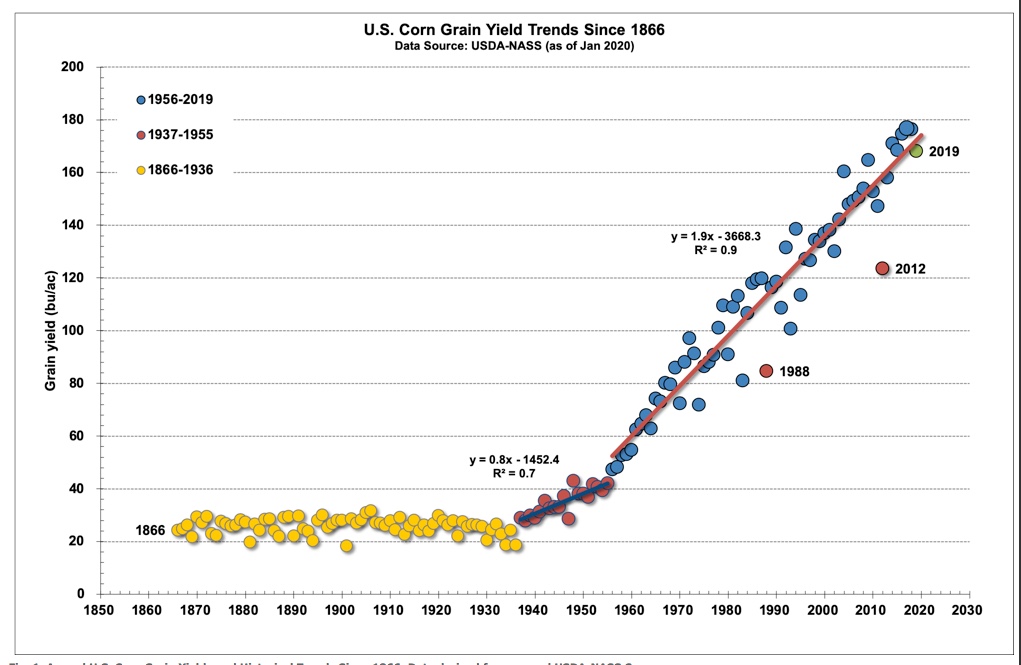
Look at this figure of corn yields per acre (1). Yellow is the "old age" where yields were stagnant. Red is when fertilizer began to be used. Now the huge slope change, has been in exploiting genetic hybrids. GMO allows protection of desirable hybrid traits that might be lost in breeding, introduction of traits to to other strains. Traits of interest are primarily around lessening usage of fertilizer, lessening usage of insecticides, as these are all input costs the farmer would rather not pay especially if they can get the same yield without paying. Thank you GMOs for keeping this linear change in yield even over the last 15 years! Could you believe we improved our corn yields substantially over these 15 years? Remarkable the work biologists do in the quiet of their field.
But of course, lay people just think it is a big conspiracy. They don't understand any of this. They think GMOs are copyright but that belies a lack of education of the last century of agriculture development, since that doesn't make sense as farmers have been using hybrids and ordering new seed some 70 years now in certain crops. It is the nations who have to resort to reusing seed and these inferior strains that are suffering poor yields and food insecurity. Over here, we feed far more with far less land under the plow every year. Their yields are still stagnant at historical levels. And climate change is coming for them, while we are understanding the very genetic basis of our yield improvement. They will be using seeds we engineer for them to be high yield in their changing environment to survive widespread famine in the coming decades. GMO is the greatest human invention, more important than even computers.
I mean, it's both things. Humans are just really good at agriculture by now. Most countries, even those that we perceive as poor, produce crops well in surplus of their own nutritional needs and can often scale up to produce multiples more.
It's no exaggeration to say we can support feeding 100x the human population with current agricultural land and techniques (assuming you can modify their diets). Largely due to GMO, fertilizers, and industrial farming.
Exchanging e.g. grains for beef is not 'lost' anything, even if theoretically the former gives more calories. Nutritionally beef is just more valuable. Calories isn't the only thing we need apparently.
Aha. All the grass humans could eat instead of the cows. Not all land is great for growing crops at. Other land is just good for growing grass for cattle to graze on.
Ah yes, beef is produced predominantly using grad fed cows? The feed is an agricultural product produced on farmland that could be used to produce food.
I'm not a vegan or whatever, but get real with the impact of meat production.
The really good thing about this is that if we somehow do manage to "ruin earth" and lose a significant portion of agricultural production, we will just have less tasty food rather than starving to death.
Food waste is another kind of "slack" in the food supply chain that would help. Imagine how the world would look if food supply was as optimized as e.g. microchips and then we got any kind of disruption... except now you starve rather than not being able to upgrade your car.
Beef gets a lot of bad rep in environment terms because developed countries grain fed it in intensive settings. But not all cattle in the world is raised like that.
Of the total land area of the contiguous 48 states, ~45% is used for animal ag. This includes:
Land for grazing livestock at ~35%.
Land for crops going specifically to animal feed at ~9%.
Animal ag farmsteads at <1%.[1-3]
That doesn't follow. The chart is counting the number of acres of land which are used for specific purposes, not the number of cattle being raised on that land. And the category you're counting as "pasture" encompasses rangeland as well, which is used at an extremely low density (often as low as 1 head of cattle per 10 acres).
depends on the phase of development. Most beef is pasture fed for a significant period, maybe supplemented with extra feed in the winter, but still grass, etc. It's only near the relatively short end they are consolidated & finished at the feed lot.
Correct, but many lands like parts of Alberta and Texas are not very good for growing foods humans can eat. So you may as well get marginal additional calories out of the non-productive land via cellulose digesters.
isn't the obvious answer not to eat less beef but rather not produce beef super fast with grain feed. if the beef we ate came from grass lands + hay in the the winter it would cost more, but would dramatically reduce the crop consumption...
Here in the UK, we use silage because the weather is a bit too variable to trust with letting hay dry out. It feels like it's probably more energy-dense and has more nutrition in it, you certainly don't need to feed as much.
Other things that work well are sugar beet (grows well as part of a cycle of crop rotation, clears weeds pretty well) and all that barley left over from brewing beer and making whisky.
Even soya-based cattle feed is made from the tough cellulosey bits that humans can't eat. If you want to try, I'm sure I can get you some - but maybe have something on hand for the inevitable constipation because it is all fibre.
Another factor that these studies seem to miss from the beef question is the fact there is more pasture land than viable agriculture land. Beef are often grazing on marginal land that would not be fit for much else. Clearcutting the amazon to meet beef demand is one thing but that isn't the case for I'd guess most places they have been farming beef for the past 100 years.
Hmm, I wonder if beef is more expensive than chicken to reflect the inefficiency in its production? Oh it is. So it must then be that people just prefer the flavor and taste of it as compared to cheaper meats then.
Since about 2019 I have been anemic. My iron levels were just a hair above being low enough to require an immediate infusion, and my doctor kept pushing me to eat more iron. She would often ask if I was a vegetarian or vegan, presumably she was assuming I was bad at it. I would always tell her the same thing. "I don't eat much beef but I do eat it"
Last summer I was diagnosed with celiac. Suddenly it all makes sense. I'm low on iron because my gut cannot absorb it.
So I start eating gluten free, and I start eating way more red meat than I used to, because building your iron levels takes a lot more iron intake than maintaining it. Now, about 8-9 months later I'm finally starting to feel better and my blood tests are showing my iron slowly creeping out of the danger zone
My nutritionist tells me that recovering this quickly would have probably been just about impossible for a vegetarian or vegan, without having an iron infusion done.
Anyways. Beef is kind of an important thing in our diets, that's all. Now that I'm back to a more normal level I'll go back to eating less of it, but I am now very conscious how important red meat is in a rounded diet
Edit: I guess my point is that calories are only part of the picture when it comes to food and there are a lot of other concerns as well, which are arguably more important to being healthy. You get calories from basically anything food you eat (assuming it's not some kind of engineered zero calorie diet food) but other minerals and vitamins are harder to source.
> My nutritionist tells me that recovering this quickly would have probably been just about impossible for a vegetarian or vegan, without having an iron infusion done.
"probably been just about impossible" doesn't mean "impossible", it more likely means changing your eating habits to a point where you'd have to be really conscious and careful of what you eat iron-wise unlike someone without Celiacs (vegan or not) or someone who likes and can afford beef and can eat as much of it as they want.
There are lentils, beans, tofu, dark leafy greens and other sources of iron. There are iron-fortified foods. IIRC there are other considerations that might prevent careless or food-addicted people from getting enough iron like vitamin C to help with the iron absorption or not eating foods that decrease it.
There are plenty of vegans with Celiacs who manage their iron adequately. But even if you're one of those cases where iron needs to be supplemented, even IV - why not? If you disregard all the arguments against beef or animal products in general it's easy to make the argument that beef would be the best solution.
This reads like appeal to authority (the nutritionist) but a lot of nutritionists take the easy road ("just eat beef") or aren't good at all (haven't kept up with research). That's true of the majority of doctors and the majority of programmers (something people here will be able to relate to in case they haven't realized how useless most doctors are). I've been in and out of hospitals for several relatives for years and have heard doctors tell me outright falsehoods that show they have a only basic understanding of something. That makes sense since those doctors must know about so much more than the patient (thousands of diseases, lots of scientific knowledge about biology) but with a depth-first search into a topic you can spot how most of them have either stopped reading new studies or have lost their motivation to explore all option or have just stopped caring for providing the best kind of care. I hope people here don't have to go through what I have. That was a bit of a tangent, but I already wrote it so I'll keep it as a mini-rant.
> Beef is kind of an important thing in our diets, that's all. Now that I'm back to a more normal level I'll go back to eating less of it, but I am now very conscious how important red meat is in a rounded diet.
That's not really true. I'm sure you could ask vegans or vegetarians or Hindus or anyone who doesn't eat beef but has Celiacs and you'd get a whole bunch of options for managing it. Sure, you'll find ignorant people who think eating fruits all the time is enough but that's the same kind of carelessness that leads to non-vegans eating the standard Western diet all the time or doing other basic mistakes.
The same is true for almost everything. Almost nothing is "an important thing in our diets". People live without nuts or fruits or vegetables or legumes or meat or eggs or dairy (not all at once, of course, although I wouldn't be surprised if someone managed to avoid all these) and are able to manage pretty much any disease other groups of people can manage.
> calories are only part of the picture when it comes to food
True, people should care about the macros and micros. But with the internet it's trivial to do so both wrt learning what does what and how much is needed, and to track how much one eats from each.
Another alternative take : calories don't exist, food don't contain "calories", we can't isolate a system to count calories in and out. It's mostly believing something because society claims others supposedly serious people think think they exist.
false comparison, as most calories cattle consume are from things people dont eat, even if there are simmilar variets of plants that both people and animals eat, they are not interchangable.
Animals also eat huge quantities of human food, that has been rejected through some technical consideration, just size, as many crops produce many fruits or vegetables that are iether too large or small to be processed, or are misshapen or damaged, cow dont care nom nom nom, gone by the ton, and the trucks are still comming.
The true unforgivable waste is by people over eating, wasting, throwing away, and destroying good foog for countless beurocratic reasons.
it seems disingenuous to problematize beef. it turns grass into human energy and also requires civilizational practices that create and preserve human dignity and animal welfare. mainly, the so called problem serves to centralize the problematizer themselves. their arguments from a position of centrally planning and managing food economies are intellectual tarpits. however, that our food supply and rural ways of life have the attention of the perpetually concerned is worthy of note. when they start with their opinions, mind your wallets and assets. in short, avoid.
The calories cows eat are ... useless to humans. We cannot digest cullulose (grass) and most of the rest of the things we feed to cows. Anyone throwing this number around has an agenda, and is not objective
Most pasture is land that cannot support human-edible crops. Cows eat low quality grass that needs no fertilizer or pesticides. Stuff that lives in very alkaline soils, etc. Cows and us, we do not compete for farmland.
The grass most cows eat also need to be planted. The point of this post is that we could be planting stuff we can eat so you don't have to 'pay' the conversion cost.
In India, for instance, dairy cattle are fed almost exclusively on crop residues and by-products. Crop residues being what's left over in the field after you harvest and by-products being what would otherwise be waste left over after you process for human use.
Elsewhere, in addition to crop residues/by-products, you also have natural grasslands that aren't planted or irrigated, legume feed grown between major crop seasons when you can't grow anything else that also replenishes the soil and feed grown on otherwise marginal land or barely managed land.
Certainly some crops grown for cows would be edible by humans or the land repurposed for growing crops edible for people, but there's often a cost involved like heavier fertilizer requirements, pesticide use, water requirements, added infrastructure and/or labor.
The grass cattle can eat (which doesn't need to be planted; most people around me don't regularly plant their pasture) is not stuff people can eat, and can often grow in conditions that can't grow people-food.
Specifically, they can eat stuff that doesn't require constant fertiliser inputs, where as people-food generally does need a lot of fertiliser inputs and needs more intensive herbicide/pesticide application.
A balanced approach is to go, "Hmm, it's probably a good idea to raise cattle, chickens, and other animals, and also to grow all kinds of produce and staple crops as well."
No, not all land isn’t the same. It is far more profitable to grow a high value crop vs plain grass. But some land just isn’t great for other things than grass. You have large cattle farms in Australia where you can’t grow anything other than grass and other wild plants.
90% of the feed they get is not for human consumption. But the rest that feed is for human consumption. And that human-edible feed makes up 75% of all US cropland. Most of our crops are grown just to feed cows. Meaning the majority of the grain we produce is going to grow a steak, when it could be used to feed many more humans than a steak will.