Please consider extending the game at least by a couple weeks! I’m very curious what percent of all California payphones could be captured with an extended game. I know the game’s phone number isn’t free but I’m sure it could be largely covered by donations.
Without even going and playing the game yet, it’s already let me understand more of the local geography. Lots of small nursing homes, behavioral institutions, and halfway houses have a payphone. Places that thankfully I haven’t had to think about and didn’t even know were there. I doubt most of these will be captured.
Many have lamented the demise of the payphone but it really bears repeating. If someone loses or is robbed of their phone, they have to rely on the trust of strangers (when they may be looking pretty rough themselves) or scrape up $20-40 for a prepaid phone at a store that’s open, rather than calling at a payphone that’s open 24/7 for 25 or 50 cents or even for free with a collect call.
Landline phone calls should just be free at this point. Put like 0.0001% of mobile profit into a fund and surely you can maintain the existing POTS payphone base. POTS-quality voice is like a rounding error in bandwidth, but we're saddled with POTS-era costs for connections.
You are underestimating just how many people that are out there that want free long distances calls lol. I worked at a phone company and this was a never ending persistent security issue. There are lots of tricky ways to get someone to pay for your long distance call. If the pay phone was free then the local provider would be on the hook for those calls.
Just block long distance calls right? If it was that simple it would not be a persistent issue.
This is amazing. I would love to have this game in France! We have a geocaching scene (https://www.geocaching.com/, https://france-geocaching.fr/), but I really like the idea with payphones and this system of calling to claim findings.
The "love letter to a disappearing piece of infrastructure" bit makes me think of the payphone pictures that are published in each of 2600 magazine issues: https://www.2600.com/payphones
Another cool "just get out there" thing is the Degree Confluence Project. Just checked, and even the web site is still old school. https://confluence.org/
I've been peripherally involved in an early stages effort to build something similar for the entire nation (https://reportapayphone.com/), and became aware of this just recently. It's a really great example to aspire to, in terms of the level of polish. I do find the time limiting odd; our goal is to identify as many payphones as possible this way.
Unfortunately the state of payphone-related records is extremely poor, with many ostensibly-active PSPs having quietly gone out of business, other PSPs reorganized without reregistering, and states themselves keeping PSP records very poorly. Throw in small-scale COCOT operations and the result is that there really isn't any authoritative database of possible payphones, so this website's map is going to be missing some. It will also include many that are nonfunctional, as today's PSPs seem to do close to zero maintenance and out of service phones stay that way for years.
Some of the nation's largest PSPs have become ghosts, with the phones still operating and able to accept payment, but the PSP completely unresponsive to efforts to contact them. It's a very strange afterlife.
I'm absolutely going hunting for some nearby payphones this weekend!
In the recording on this one [1] the caller states that the payphone is on the caltrain station platform, but on the map it's about 1000 feet from there. Searching the address on google maps correctly shows it at the station, though.
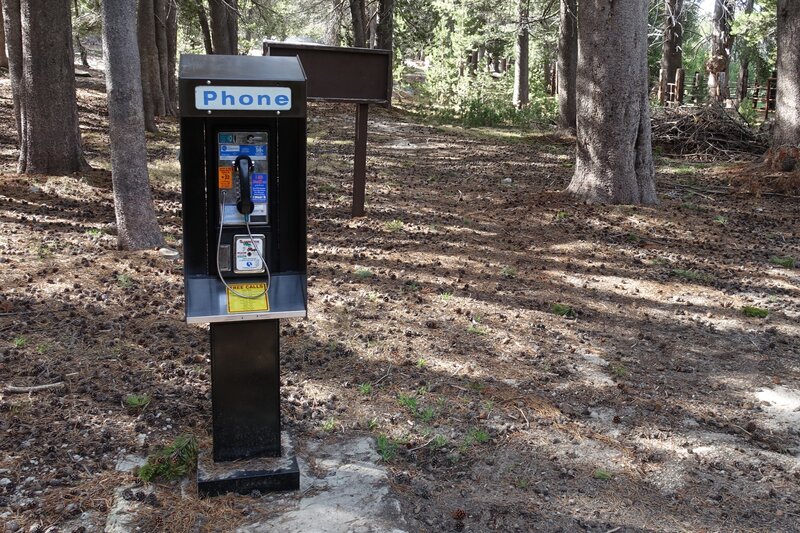
I know of a working payphone that is not on the Payphone Go map. Photo: https://i.postimg.cc/Dw4sCDpJ/payphone.jpg
The fact that I know of one makes me wonder, are there are others? Is the list the author obtained from PUC incomplete? Is this phone operating unlicensed? Has the phone died since I last visited a year ago?
I just visited the closest one to me during lunch. There was just a single dot in the middle of a huge county building. I had to walk through security to get there. I asked if there was a payphone around and the guard said no. Luckily someone else knew. One out of two phones didn't work. The other did, so now my best clean original joke can be heard by anyone.
There are three other phones in my city, two in a hospital, one in potentially a corrections facility? I'll stop by on my way hope.
Ya know, I just spun up a version of a user-driven exploration game, as an homage to the sf0.org from back in the aughts. https://irl2-production.up.railway.app/
Google auth still not hooked up, but otherwise good enough for now. And it's open source.
This is a fun idea. It occurs to me that I would enjoy seeing unvisited phones on the map in a different color. [Edit: Oh, now I see green dots for visited phones. Was this always there and I just hadn't noticed?]
Been following this guy's work for a bit now, and I feel like it's more in the spirit of what art is supposed to be than what you see in 99% of galleries these days.
Apropos of absolutely nothing, and impossible to prove, but I've long suspected I might be the youngest person in the U.S. to have won tickets from radio stations both from a rotary phone (at home, ~1989) and from a payphone (while I was delivering pizzas ~1990).
Unfortunately I've never really taken advantage of my absurd luck to do something more useful, like retire early.
I think it's harder to spoof toll free numbers. For example, you can't block caller ID in the same way. I'm sure it's still possible to spoof, but just might be a little harder.
It looks like Mark Thomas maintained a phone number database up until 2007 or 2023 for many areas in the USA. I guess that could be a basis for starting 'my own' instance of payphone-go, maybe with twilio (or equivalent) to receive the calls.
This works because California requires licensing for payphones and Riley was able to FOIA state payphone database. I'm not sure if other states require licenses for payphones.
That's happening piecemeal in the US as well. Any "landline" phone service at this point will be coming from a box hooked up to your internet service, quite the flip from the old days of dialup internet.
I still have a copper landline direct to a real central office; for my Mother in Law. $60/month and the phone company made it very difficult to setup 3 years ago; they really don't seem to want to be a phone company anymore.
Pulse dialing still works, and the automated voicemail system that the CO switch runs has zero perceptible latency (unfortunately, they won't give me the PIN to set it up)
The dismantling is usually faster in other countries, as Telcoms owning this equipment either are or were state owned monopolies. In the US, the payphones were probly owned and swapped and back and forth between myriad providers.
Quick telephony question: how can calls from payphones to (888) 683-6697 be toll-free for the caller? I’m Japanese, so I may be missing something, but I don’t understand the mechanism that makes this free (or low-cost enough) to run as a free service.
Most countries have some numbers with receiver pays or reverse billing as a feature. Sometimes called 'free phone'.
My research says Japan has several prefixes, 0120, 0800, 0088, 0531, although not all phone numbers in these prefixes are available to all callers.
In the US, holders of a toll free number pay their carrier a per minute rate (sometimes with billing increments of 1 second), as well as a fee per call from payphones.
The per minute pricing is pretty reasonable typically one or two cents per minute; I think the per call cost from a payphone are more significant, although I don't see this listed by most providers; I seem to recall it being pretty hefty (and some toll free numbers would not accept calls from payphones as a result), but maybe changes in the network and intercarrier billing have resulted in a smaller fee or it's just not relevant to most people because payphones are hard to find.
In many cities there are "Emergency Call Boxes" throughout the streets that are distinct from payphones but operate similarly in that they allow you to get in contact with emergency services.
With Asterisk and some voip client (even some modern phones) and some ZMachine modules you could play from Zork to tons of adventure games for the ZMachine at IFDB, from Anchorhead to Tristam Island.
Which is kinda the reverse of this, reusing phones to play a text adventure.
This is brilliant and makes me wish even more that I still lived in California -- hopefully this could extend the the entire Left Coast if there's enough payphones to warrant it.