Modern mobile browsers can render traditional sites just fine. It was the killer feature of the original iPhone.
So I really fail to understand why you'd make a mobile version of your site that completely breaks on mobile.
We have the entire planet storing all sorts of important business and personal data digitally - and no longer a good, common way to ensure it lasts even a decade.
New computers don't have them and haven't for a few years. I purchased a drive recently and to get a quality drive, I had to go for a NOS pioneer drive, or get another LG, and the LG drives are kid-of shit.
I'd love some kind of external tape drive that I can connect with USB-C, or USB-3...
But everything is SAS? And no way to convert SAS to SATA?
Recommendations?
I still have a ZIP drive around with a parallel port connector. I haven’t owned a computer with a parallel port in 20+ years.
I probably also have a QIC-80 tape drive around somewhere.
LTO drives are expensive but they are very well designed and it is the most reliable portable storage format available. Full LTO tapes in a good fire rated safe really provide a fantastic sense of security. The cost of the drive is amortized over the total bytes you store.
On one hand, yes, it's dying. On the other, a PS5 can play DVDs, so there's one class of popular, modern hardware where it's alive and well.
> Verbatim clarified that these discs were advancements. The technical changes resulted in a different appearance and the ability for higher burning speeds, the changed media-ID was due to an adaptation with regard to other Verbatim products. Verbatim had already shipped the first modified media in early 2022. The data security of the new discs is not inferior to that of the old discs: Data should also last 1000 years, according to the manufacturer.
I have 3 copies so I can check the archive version, active storage volume, and local version to see if any lost integrity in the transfer process.
I’m curious how it would compare against my old CDs and DVDs that were previous backups. My work does something similar for tape drive data.
Granted, if one no longer has the mechanical drive, or if the disk errors out beyond the threshold where the extra ECC can correct the errors, the data's still lost. But it (dvdisaster) does provide some protection from the "bit-rot" case where the disk slowly degrades.
Also also, M-Disc is like Imax, a theater could have that label because it projects 70mm film into a dome or because it's a regular movie theater with a lower resolution than your phone screen that licenses the rights to the name. There are M-Disc DVDs that use a special archival technology that requires compatible drives, but the M-Disc Blu-Ray discs are made with regular Blu-Ray manufacturing technology. With both Imax and M-Disc, they require a minimum quality level to license the trademark, but exceeding that quality level is far from exclusive to that trademark.
would be interesting how that M-disc looks - and reads - today 10 years later..
Please do not say LTO tapes. The drives are huge, noisy, expensive, and they have a very quick deprecation policy (new drives cant use old tapes).
More seriously; you can buy used lto-7/8 for very little these days, and the tapes are extremely cheap per gb. The drives are somewhat loud; it’s not a beside device for sure. I’m finding it a bit of a pain to manage a good backup strategy with them.
- You suggest buying multidecade old drives that are no longer manufactured, have weird interfaces that your 2026 PC no longer has, are expensive, large, noisy
- You then mention LTO7 which will not read your LTO4 tapes and is not just expensive but literally out of reach economically for single home
Basically LTO is a terrible backup strategy unless you have a lot of money regularly that you will spend in order to upgrade your entire equipment every two/three generations (otherwise your newer equipment wont read your old tapes). Or you have so much data to backup that cost of drives is not really an issue.
I have stored a lot of data on HDDs, and the only reason why I have not lost any of it yet is because I have always used duplicate HDDs. After 5 years or more, most HDDs had some corrupted sectors, but they were not in the same positions in the duplicate HDDs, allowing complete recovery of the data.
The reality is that both tapes and HDDs suck. What is really needed for long-term storage is a write-once memory with a lifetime of 100 years or more, based on an open standard that would ensure the availability of readers in the future.
If such a memory would use optical reading, it would have to use a great number of layers, filling a 3D volume, in order to achieve densities comparable with the magnetic media. While several research projects in this direction have been announced from time to time, until now none of them has resulted in a commercial product.
I mention LTO 4 because you can today, buy multi decades old LTO-4. Brand new. So in multiple decades from now, I assume you’ll be able to find LTO-7 or 8; brand new. A drive might cost a little more to obtain, but given the plethora of used multi decades old lto currently out there, it seems reasonable to expect that in a recovery scenario you’ll be able to shell out for the right drive.
But yes for most HDDs or the cloud are better. No need to get spicy about it.
Individual used drives aren't too expensive (or at least didn't used to be). Libraries, in contrast, do tend to be more expensive (and also a lot more trouble to ship).
You say "it can read from one generation ago" as if it was some great thing about LTO when it is just a laughably fast obsolescence policy and what really kills it for a home user.
A blueray drive manufactured today can still fscking write to a 90s CD-R from way before LTO even existed.
For magnetic media, the gaps in the magnetic circuit of the read/write heads are optimized for a certain dimension of the bits from the tape material and the efficiency of the read/write process greatly diminishes for other bit sizes.
So there is no obsolescence policy, but there is a real technical difficulty in ensuring compatibility with older magnetic media with different bit densities.
It is not as simple as claiming that optical drives have it easier technologically. If anything, I would claim that tapes have it simpler, definitely for reading at least. There is _nothing_ preventing LTO from retrocompatibility other than market forces.
Most optical discs do not have any guarantees about lifetime and the worst of them may survive only a few years.
There have existed special quality optical discs with gold mirrors that were guaranteed for 100 years, but those are no longer produced and a single modern tape cartridge stores as much data as thousands of those discs.
There are several mechanisms of degradation of optical discs. If the plastic does not seal well enough the metallic mirror, the metal can become oxidized and transparent, so it no longer reflects enough of the laser light. This is why certain archival discs used gold mirrors, which cannot oxidize. The plastic resin may also degrade in various ways and cause disc deformation.
not hard to find stories about data on LTO tapes being unreadable after 5 years. The same as stories of data on even the worst CD-Rs being still readable after 30 years ( i can personaly attest to that).
I had several hundred CD-Rs. Most of them were OK, especially the gold archival CD-Rs from Kodak, so I have migrated the data from them mostly to save space and improve access speed, not for them being too old. Nevertheless there have been a few that have gone bad, but I had duplicates for all of them, so I did not lose the data. Had I not been cautious, I would have lost some of the data.
The main problem of optical discs is their much too low capacity in comparison with magnetic media. A small suitcase with tape cartridges contains as much data as a big cabinet full of the most dense optical discs.
You can get 5.25" bay drives.
Sure but old drives are widely available at low prices.
Unless you have a server motherboard with an on-board SAS controller, you need to buy a SAS HBA card, put it in your desktop and also buy a compatible SAS cable, in order to connect an LTO tape drive to the computer.
New tape drives are extremely expensive, e.g. $4500 for the last generation of LTO-9 tapes (18 TB/cartridge), but if you store at least a few hundred TB of data you recover the cost of the drive from the cost difference between HDDs and tape cartridges.
I have an older LTO-7 (6 TB/cartridge) tabletop drive, which has cost me $3000 about 7 or 8 years ago (new), and there are several years since I have recovered its cost.
If you do not intend to store more than 100 TB, the cheapest solution is to buy external HDDs, but for long term storage you must plan to migrate the data periodically, as the lifetime of HDDs is hard to predict and unlikely to be much greater than 5 years.
Literally every single reply to this comment mentions LTO; never change HN.
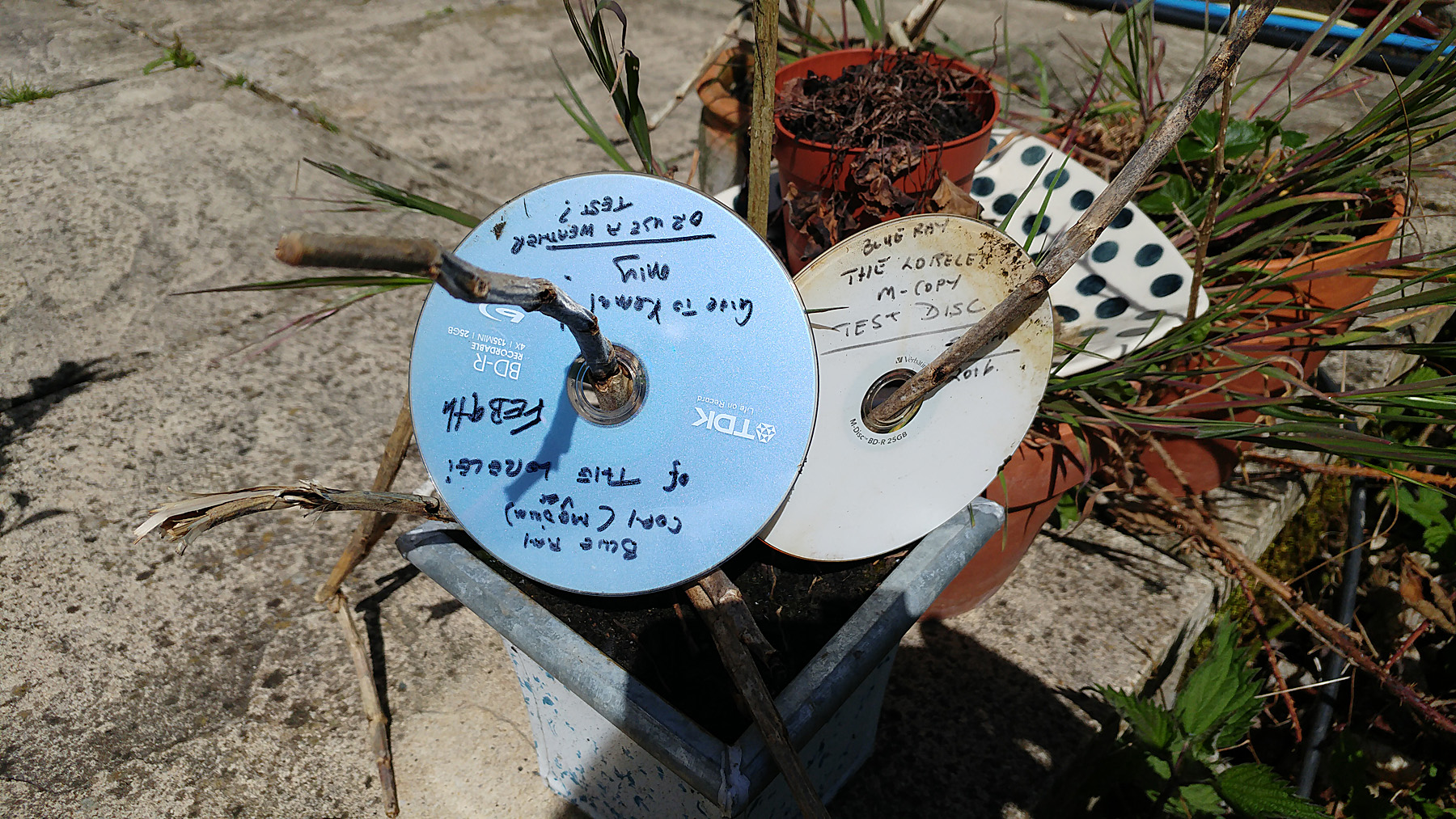
Granted, archival discs aren't designed for full-sun exposure to start with, so in theory, the failed disc could have outlasted the other under real-world archival conditions, and this test wouldn't reveal that.