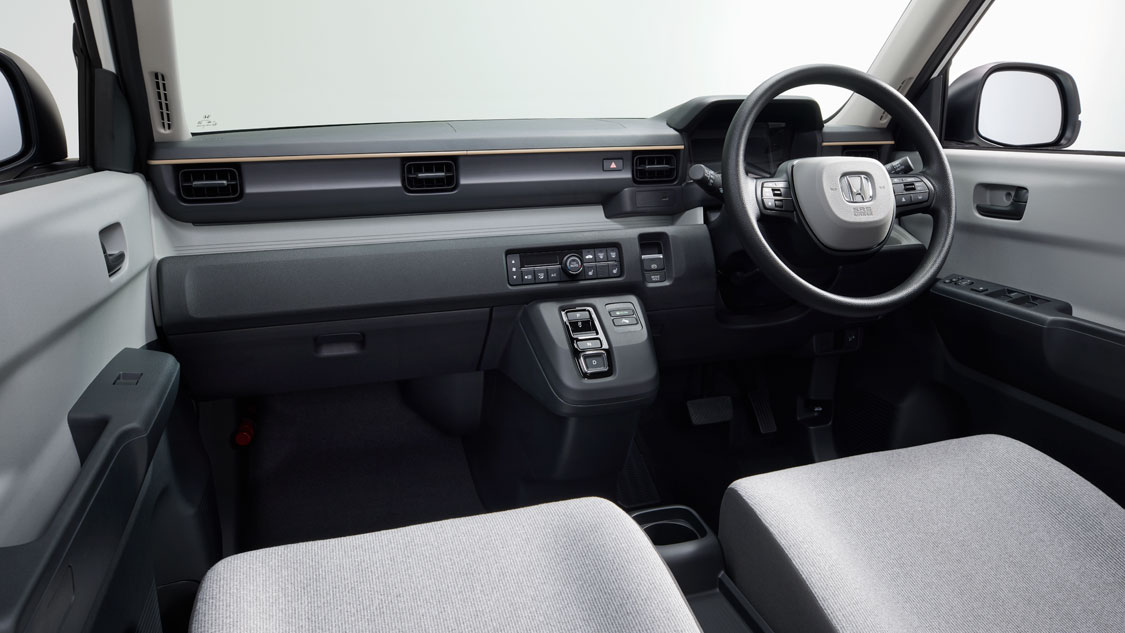
Funny how “game engines” are now car parts in 2026.
Can I just have an electric car that’s a car and nothing else? Seats, wheels pedals, mirrors, real buttons, no displays just a aux jack. I’d buy it, hell I might even take the risk and pre-order it
In the US, no. Backup cameras are required by federal law as of 2018. The intent of the law was to reduce the number of children killed by being backed over because the driver couldn't see them behind the car.
I have unusually good spatial skills. I have parallel parked and reverse parked perfectly every single time for over 5 years…
…but no matter what, I cannot see behind my bumper. No mirror on any car points there.
There was the chip shortage during covid which held car production back becasue the auto makers couldnt source their chips fast enough. I am waiting to see if the current supply issue for ram chips modules will produce a similar effect.
Was there a single mass market consumer car sold in the United States in this millennium that didn’t already have processors and RAM in them?
I would be absolutely shocked if there was a single car for which the relatively recent backup camera requirement required them to introduce processors and RAM for the first time.
Call me old fashioned but in my opinion, processors/ram/chips/components are a good trade-off versus squished children
You shouldn’t need any dedicated RAM. A decent microcontroller should be able to handle transcoding the output from the camera to the display and provide infotainment software that talks to the CANbus or Ethernet.
And the bare minimum is probably just a camera and a display.
Even buffering a full HD frame would only require a few megabytes.
Pretty sure the law doesn’t require an electron app running a VLM (yet) that would justify anything approaching gigabytes of RAM.
So what microcontroller do you have in mind that can run a 1-2 megapixel screen on internal memory? I would have guessed that a separate ram chip would be cheaper.
It's so silly when they make some "Advanced Technology Package" with a VGA camera and a 2-inches-bigger infotainment screen that's still worse than junk from Aliexpress, and charge $3000 extra for it.
I know it's just a profit-maximizing market segmentation, but I like to imagine their Nokia-loving CEO has just seen an iPad for the first time.
They might as well be complaining about the costs of a rear view mirror, it is nonsense from the start. If a $20 gadget breaks the bank on a $30,000 minimum vehicle, they are a shitty business to start with and we should all be clapping our hands when they go out of business.
Blaming trucks and SUVs for everything is a favorite pasttime of internet comments, but all vehicles benefit from backup cameras and collision detection sensors.
The US was ahead of the EU in requiring backup cameras on new vehicles.
The majority of pedestrian accidents aren't involved with backup cameras.
Are you just trying to turn this into a US vs EU argument?
Americans drive significantly more miles per year, and larger/more comfortable cars are in part needed because Americans spend far more time in their cars than Europeans.
Euro governments are also increasingly anti-car, which means citizens are loosing their freedom to travel as they wish and unreasonably taxed, policed, and treated like cash cows for the "privilege" of driving.
Most of my European friends brag about how they can get anywhere via train and how much more comfortable it is to travel that way. When I visit Europe I have to agree. Just haven't really seen this viewpoint, though I do think I would feel this way as an American if I moved to Europe to some extent (though I'd be extremely happy to have viable mass transit).
So pedestrian deaths would start rising again.
I have a 2016 vehicle with no console screen and they have saved me from hitting all sorts on things, and are sensitive enough to detect minor obstacles like long grass.
https://www.cdc.gov/mmwr/preview/mmwrhtml/mm5406a2.htm
I suspect older children are more likely to be able to be aware of their surroundings and have better gross motor skills to react.
The perk of not having to twist your body around while steerins is also pretty nice.
Was a great example of the ridiculous expectations some of us Americans have on ridiculously huge vehicles.
Backup cameras are required for new vehicles in a lot of markets: EU, Canada, Japan, and more.
So it's not just a US requirement.
It doesn't need to be a giant infotainment display.
The problem with modern cars is that everything is so heavily integrated and proprietary. If I swapped out the OEM touchscreen, apparently I would also lose the ability to set the clock on my instrument cluster. Now that this has become normalized, automakers have realized they can lock Android Auto/CarPlay behind a paywall and you’ll have no recourse but to buy one of those tablets that you stick on your dashboard and plug into the aux port. If your car still has an aux port.
I’m excited for the Slate, but unfortunately I have the feeling that the people who buy new cars aren’t the same people that want the Slate. The rest of us who keep our 20+ year old vehicles reliably plugging along don’t make any money for automakers.
Every single car I have been in in the last 5 years or so has Bluetooth. No need for aux ports in this day and age, especially when devices dont have headphone jacks anymore.
Are you stuck in the 2000's?
Bluetoothing to your car is to me the same energy as using "wireless" charging stands for your phone. You are just replacing a physical tether with a less efficient digital tether of higher complexity for no actual gains.
One of the example uses given in the talk is 3D tutorials, which I could imagine being handy. Not sure I'd want to click on the car parts for it but with the correct affordances I could imagine a potentially useful interface.
It's like, at least one exists in Japan, on used market even, if you absolutely have to have one, I guess
0: https://www.honda.co.jp/N-ONE-e/webcatalog/design/images/e_g...
1: https://driver-web.jp/articles/gallery/41396/36291
2: https://www.carsensor.net/usedcar/detail/AU6687733258/index.... | https://archive.is/gbBzc
Power windows are standard. 169hp. Automatic climate control, central locking and key fobs, Automatic emergency braking and other radar based features. Digital gauge cluster. Modern infotainment. Modern crash safety, which is really good compared to 20 years ago.
That's a lot of car for $10k in 1996 dollars.
That's ignoring the $3k in fees, taxes, and whatever scam the dealer runs.
The reason we don't see more of it is that selling one $23k Corolla to one value minded shopper can't make line go up as much as selling one $60k MEGATRUCK to one easily influenced shopper. The new car market is exclusively for people who buy new cars regularly, and are therefore willing to get very bad deals for cars. The market is driven by people who self select for bad ability to parse value.
There has been real price decrease in small cars!
Crazy to think had the federal subsidy not been cut, that car would be possible to get for around $15k. Unheard of.
"V8"
"Which kind of V8?"
Seems almost inevitable. Game engines end up supporting user interface elements and text with translations, but with an emphasis on simplicity, performance, and robustness. Many currently trending user interface stacks readily generate bursts of complexity, have poor performance even with simple usage, and are buggy and crash prone.
I loved the Viper, but its spartan interior and features list were its detriment.
To have a decent travel experience in an EV you'd likely at least need this data ported out to your phone via an OBD adapter or CarPlay / Android Auto integration with an in-car infotainment display.
Ol' Dirty Bastard? I jest, but I think the theory behind wanting an 'On-board Diagnostics' [1] connection would be to get data from the vehicle. You can get cheap bluetooth OBD-II adapters to transmit that info to your phone, it's not a given. I don't know much about electric cars, but if you want your phone to know the fuel level in an ICE vehicle then you'd need this kind of connection.
More expensive cars will have more electronic. They kinda want to sell them.
There is functionally no difference between the powertrain of an electric road car and a brushless drill. How much software is there in your brushless drill? More than zero, far less than an electric road car.
Personally, I'd be happy with some kind of situation where:
1. You have a small in-dash touchscreen, as most small sedans have these days, as the basic level of "backup camera and radio view" 2. Everything the car does has a physical button so you don't NEED to use the touchscreen 3. The car has a USB-C port that can power a tablet and which provides a standardized interface that e.g. iOS and Android can interface with, so that users don't have to worry about their new OS doesn't support the not-updated app, or the app doesn't support their not-updated device 4. Sell an optional tablet mount that attaches to the dash the way a built-in one would be 5. Sell an optional 'tablet' that does nothing but interface with the USB-C port and provide what it needs, in case someone wants a larger screen without having to buy an iPad Pro
Then again I don't drive, so I'd be happy with none of this also.
You can buy a tubular frame chassis for Beetle-based kit cars from a factory in the south of England, that's been adapted to take modern coilover suspension and an MGF or MGTF engine and gearbox, because Beetles are so rare that anyone wants to put the engine back into a Beetle.
I reckon with a minor amount of fettling you could squeeze a Nissan Leaf transaxle and a sufficient amount of batteries in, and still drop your Manx beach buggy shell over the top. Or any other shell you like.
You'd be running around in a solar-powered beach buggy. THAT is the future.
Game engines are probably trivially cheap to produce in 2026. You forget that Toyota sells 10M cars per year. In 3 years thats 30M cars. What does it cost each buyer for the game engine? 30 cents?
https://unity.com/blog/industry/automotive-hmi-template-take...
It might add up to a lot of money for the manufacturer who is cranking out thousands or millions of vehicles, but to the consumer buying one car it isn't a meaningful difference.
Then you had wiring each button wire I believe was $1. This wasnt 1 wire, but a few wires, power, ground, signal. Each button had them. This wasnt my job, so I didn't follow this price too much, but I asked the question at the time. I think going into the ECU, there is also a cost associated with it.
Anyway, you could assume 10 years ago, each button was $2. A car has 40-70 buttons? So its probably like $100 a car. Maybe $150 or $200 in today's money.
Also buttons and wires break, causing warranty problems.
At the time these vehicles were selling for under $20k at the bottom, and $40k at the top. So 1% of costs were buttons.
This doesn't even include the cost of hiring ~20 engineers to handle the buttons. ~6 people to check appearance and do testing... It doesn't include the assembly costs on the line. That 1% was just the cost of button + wire.
It's a good thing that doesn't happen to giant 15" integrated touchscreens. Imagine how much of a problem that would be!
That doesn't make sense. $1 uninstalled might make sense for a fancy custom-molded button, even if it's too much for a generic button. (I'd rather have some generic buttons with labels than use a touchscreen, by the way.) But there's no way a few feet of signal wire and the proportional share of power wires get anywhere near $1 uninstalled.
Also I can find entire car stereo units with 15 buttons on them for $15? That kind of integrated button is cheap, has been common in cars for a long time, and can control things indirectly like a touch screen button if that's cheaper than direct wiring.
I have a late 90s Range Rover. It has about 12 buttons on the dashboard, most of which I never have to bother with (they do things that turn on and off the fog lamps, which I don't need to use, or adjust the air suspension, which I rarely need to use). I turn the lights off and on, and I switch the heating from "normal" to "BLAST EVERYTHING ON, FRONT AND REAR DEMIST ON, SEAT HEATERS ON, EVERYTHING ON, EVERYTHING ON, EVERYTHING UP FULL, WE'RE AN AIR FRYER NOW" mode.
What do you actually need an LCD for in a car?
I recently (as in, last night) added WebSockets to my backend, push notifications to my frontend iOS, and notification banner to the webapp. It all kinda just works. Biggest issues have been version-matching across with Django/Gunicorn/Amazon Linux images.
The problem is unless your ready to waste hours prompting to get something exactly how you want it, instead of spending those few minutes doing it yourself, you start to get complacent for whatever the LLM generated for you.
IMO it feels like being a geriatric handicap, there's literally nothing you can do because of the hundreds or thousands of lines of code that's been generated already, you run into the sunk cost fallacy really fast. No matter what people say about building "hundreds of versions" you're spending time doing so much shit either prompting or spec writing that it might not feel worth getting things exactly right in case it makes you start all over again.
It's literally not as if with the LLM things are literally instantaneous, it takes upwards or 20-30 minutes to "Ralph" through all of your requirements and build.
If you start some of it yourself first and you have an idea about where things are supposed to go it really helps you in your thinking process too, just letting it vibe fully in an empty directory leads to eventual sadness.
The way I use LLM's is that I design main data structures, function interfaces etc. and ask LLM's to fill them. Also test cases and assertions.
To the degree that those same people are now writing 10-100x more code...that is scary, but the doom and gloom is pretty tiring.
Any engineer worth their weight will always try to avoid adding code. Any amount of code you add to a system, whether is written by you or a all knowing AI is a liability. If you spent a majority of your work day writing code it's understandable to want to rely heavily on LLMs.
Where I'd like for people to draw a line on is not knowing at all what the X thousand lines of code are doing.
In my career, I have never been in a situation where my problems could be a solved by piecing together code from SO. When I say "spend those few minutes doing it yourself" I am specifically talking about UI, but it does apply to other situations too.
For instance, if you had to change your UI layout to something specific. You could try to collect screenshots and articulate what you need to see changed. If you weren't clear enough that cycle of prompting with the AI would waste your time, you could've just made the change yourself.
There are many instances where the latter option is going to be faster and more accurate. This would only be possible if you had some idea of your code base.
When you've let an agent take full control of your codebase you will have to sink time into understanding it. Since clearly everyone is too busy for that you get stuck in a loop, the only way to make those "last 10%" changes is *only* via the agent.
You can already see people running into these issues, they have a spec in mind. They work on the spec with and LLM, the spec has stuff added to it that wasn't what they were expecting.
And again, I am not against LLMs but I can be against how they're being used. You write some stuff down, maybe have the LLM scaffold some skeleton for you. You could even discuss with the LLM what classes should be named what should they do etc. just be in the process so the entire code base isn't 200% foreign to you by the time it's done.
Also I am no one's mother, everyone has freewill they can do whatever they'd like. If you don't think you have better things to do than to produce 3-5 pieces of abandonware software every weekend then good for you.
I've only ever joined teams with large, old codebases where most of the code was written by people who haven't been at the company in years, and my coworkers commit giant changes that would take me awhile to understand so genAI feels pretty standard to me.
I've tried fixing some code manually and then reused an agent but it removed my fix.
Once you vibe code, you don't look at the code.
Truly one of the statements of all time. I hope you look at the code, even frontier agents make serious lapses in "judgement".
It's sad to think we may be going backwards and introducing more black boxes, our own apps.
Offloading your thinking, typing all the garbled thoughts in your head with respect to a problem in a prompt and getting a coherent, tailored solution in almost an instant. A superpowered crutch that helps you coast through tiring work.
That crutch soon transforms into dependence and before you know it you start saying things like "Once you vibe code, you don't look at the code".
To the AI optimist, the idea of reading code line by line will see as antiquated as perusing CPU registers line by line. Something do when needed, but typically can just trust your tooling to do the right thing.
I wouldn’t say I am in that camp, but that’s one thought on the matter. That natural language becomes “the code” and the actual code becomes “machine language”.
And therein lies the problem
I've worked places where junior made bad code that was accepted because the QA tests were ok.
I even had a situation in production where we had memory leaks because nobody tried to use it for more than 20 minutes when we knew that the app is used 24/7.
We aim for 99% quality when no-one wants it. No-one wants to pay for it.
Github is down to one 9 and I haven't heard them losing many clients, people just cope.
We've reached a level where we have so much ram that we find garbage collection and immutability normal, even desired.
We are wasting bandwidth by using json instead of binary because it's easier to read when have to debug, because it's easier to debug while running than to think before coding.
For me, GUI and Web code falls into "throwaway". I'm trying to do something else and the GUI code development is mostly in my way. GUI (especially phone) and Web programming knowledge has a half-life measured in months and, since I don't track them, my knowledge is always out-of-date. Any GUI framework is likely to have a paroxysm and completely rewrite itself in between points when I look at it, and an LLM will almost always beat me at that conversion. Generating my GUI by creating an English description and letting an AI convert that to "GUI Flavour of the Day(tm)" is my least friction path.
This should be completely unsurprising to everybody. GUI programming is such a pain in the ass that we have collectively adopted things like Electron and TUIs. The fact that most programmers hate GUI programming and will embrace anything to avoid that unwelcome task is pretty obvious application of AI.
There was a passing comment about "when we open up the GitHub repository" in the talk. So it's not open yet, but they've suggested it might be in the future.
That said, this is cool and I would have probably celebrated a similarly fun project in their shoes. Perhaps the real accomplishment here is getting Toyota to employ you to build a new, niche game engine.
They already tried other engines, such as Unity. The team didn't just go off and build something without trying existing solutions first.
I don't know how bloated Godot is, but AFAIK libgodot development started as part of Migeran's automotive AR HUD prototype so I'm surprised to hear it has poor startup time for a car.
https://github.com/google/filament
but if they're targeting embedded systems, maybe they haven't prioritized a public web demo yet. If the bulk of the project is actually in C++, making a web demo probably involves a whole WASM side-quest. I suspect there's a different amount of friction between "I wanna open source this cool project we're doing" and "I wanna build a rendering target we won't use to make the README look better."
Toyota assuming they move forward with this, might even become the main corporate sponsor since Google appears to be disinterested.
So... not PC-grade?
The UI toolkits in game engine usually suck hard, so here they started from a good UI toolkit and made it possible to make relatively performant games.
There's more info at https://www.reddit.com/r/programming/comments/1r0lx9g/fluori...
They have a fun demo of a 3D shooter in it.
I've been burned by using closed source game engines before. There's just too many edge cases and nuances that come up when debugging physics or graphical issues. I strongly recommend against using this until they become at the very least source-available.
Makes me wonder if you might eventually see the OG Flutter team move to a shop like Toyota, the same way the original React team moved to Vercel. It's nice to see open source projects be portable beyond the companies that instigated them.
  - fancy HDR rendering with reflection planes,atmospheric effects, tone mapping, camera effects, all kinds of animations for doors opening, lights turning on off etc
  - content pipelines to get all this data from digital creation tools into packages deployable on target
Bevy is the opposite of an old boring solution. It's a cool engine, but I imagine a manufacturer would like to have long-term support with 15-year timelines. Bevy doesn't offer that, and even trying to have that wouldn't be good for Bevy.
Something about games authored by a giant company that will presumably actually ship in some products: "Hello, human resources?"
Please stop, all this does is introduce new ways for things to break.