Space is a vacuum. i.e. The lack-of-a-thing that makes a thermos great at keeping your drink hot. A satellite is, if nothing else, a fantastic thermos. A data center in space would necessarily rely completely on cooling by radiation, unlike a terrestrial data center that can make use of convection and conduction. You can't just pipe heat out into the atmosphere or build a heat exchanger. You can't exchange heat with vacuum. You can only radiate heat into it.
Heat is going to limit the compute that can be done in a satellite data centre and radiative cooling solutions are going to massively increase weight. It makes far more sense to build data centers in the arctic.
Musk is up to something here. This could be another hyperloop (i.e. A distracting promise meant to sabotage competition). It could be a legal dodge. It could be a power grab. What it will not be is a useful source of computing power. Anyone who takes this venture seriously is probably going to be burned.
I'm confused about the level of conversation here. Can we actually run the math on heat dissipation and feasibility?
A Starlink satellite uses about 5K Watts of solar power. It needs to dissipate around that amount (+ the sun power on it) just to operate. There are around 10K starlink satellites already in orbit, which means that the Starlink constellation is already effectively equivalent to a 50 Mega-watt (in a rough, back of the envelope feasibility way).
Isn't 50MW already by itself equivalent to the energy consumption of a typical hyperscaler cloud?
Why is starlink possible and other computations are not? Starlink is also already financially viable. Wouldn't it also become significantly cheaper as we improve our orbital launch vehicles?
It's like this. Everything about operating a datacenter in space is more difficult than it is to operate one on earth.
1. The capital costs are higher, you have to expend tons of energy to put it into orbit
2. The maintenance costs are higher because the lifetime of satellites is pretty low
3. Refurbishment is next to impossible
4. Networking is harder, either you are ok with a relatively small datacenter or you have to deal with radio or laser links between satellites
For starlink this isn't as important. Starlink provides something that can't really be provided any other way, but even so just the US uses 176 terawatt-hours of power for data centers so starlink is 1/400th of that assuming your estimate is accurate (and I'm not sure it is, does it account for the night cycle?)
> The maintenance costs are higher because the lifetime of satellites is pretty low
Presumably they're planning on doing in-orbit propellant transfer to reboost the satellites so that they don't have to let their GPUs crash into the ocean...
Yes, but you need energy to pump heat, and that has an efficiency maximum (thx ~~Obama~~ Carnot), and radiative cooling scales with the ~4th power of the temperature, so it has to be really hot, and so it requires a lot of energy to "cool down" the already relatively cool side and use that "heat" to heat up the other side that's a thousand degree hotter.
All in all, the cooling system would likely consume more energy than the compute parts.
yes. it is how sats currently handle this. its actually exponentially effective too P = E S A T^4
requires a lot of weight (cooling fluid). requires a lot of materials science (dont want to burn out radiator). requires a lot of moving parts (sun shutters if your orbit ever faces the sun - radiator is going to be both ways).
so that sounds all well and good (wow! 4th power efficiency!) but it's still insanely expensive and if your radiator solution fucks up in any way (in famously easy to service environment space) then your entire investment is toast
now i havent run the math on cost or what elon thinks the cost is, but my extremely favorable back of hand math suggests he's full of it
You definitely _can_ the question is, can you do it by enough for a reasonable amount of money. There are a few techniques to this but at the end of the day you need to radiate away, the heat otherwise it will just keep growing. You cannot keep pumping energy into the satellite without distributing the same amount back out again.
The energy economics in space are also a bit more complicated than usually thought. I think Starlink has been using Si cells instead of III-V-based ones, but in addition to lower output they also tend to degrade faster under radiation. I guess that's ok if the GPU is going to be toast in a few years anyway so you might as well de-orbit the whole thing. But that same solar cell on Earth will happily be producing for 40+ years.
Also the same issue with radiative cooling pops up for space solar cells - they tend to run way hotter than on Earth and that lowers their efficiency relative to what you could get terrestrially.
Starlink and Falcon 9 have been an excellent pairing, Falcon 9 partially reusable rockets created a lot launch capacity and starlink filled the demand. Starship if it meets its goals will create more launch fully reusable supply by orders of magnitude, but there is not the demand for all that launch capacity. Starlink can take some of it but probably not all so they need to find a customer to fill it in order to build up enough to have the volume to eventually colonize mars.
We can tell because it’s not being treated as a serious goal. 100% of the focus is on the big vroom vroom part that’s really exciting to kids who get particularly excited by things that go vroom, and approximately 0% of the focus is on developing all the less glamorous but equally essential components of a successful Mars mission, like making sure the crew stays healthy.
Big tech businesses are convinced that there must be some profitable business model for AI, and are undeterred by the fact that none has yet been found. They want to be the first to get there, raking in that sweet sweet money (even though there's no evidence yet that there is money to be made here). It's industry-wide FOMO, nothing more.
A significant number of AI companies and investors are hoping to build a machine god. This is batshit insane, but I suppose it might be possible. Which wouldn't make it any more sane.
But when they say, "Win the AI race," they mean, "Build the machine god first." Make of this what you will.
Off on a tangent here but I'd love for anyone to seriously explain how they believe the "AI race" is economically winnable in any meaningful way.
Like what is the believed inflection point that changes us from the current situation (where all of the state-of-the-art models are roughly equal if you squint, and the open models are only like one release cycle behind) to one where someone achieves a clear advantage that won't be reproduced by everyone else in the "race" virtually immediately.
They ultimately want to own everyone's business processes, is my guess. You can only jack up the subscription prices on coding models and chatbots by so much, as everyone has already noted... but if OpenAI runs your "smart" CRM and ERP flows, they can really tighten the screws.
That may be the plan, but this is also a great way for GDPR's maximum fine, based on global revenue, to bite on SpaceX's much higher revenue. And without any real room for argument.
There should be some temperature where incoming radiation (sunlight) balances outgoing radiation (thermal IR). As long as you're ok with whatever that temperature is at our distance from the sun, I'd think the only real issue would be making sure your satellite has enough thermal conductivity.
My guess is it’s just another example of his habit of trying to use one of his companies to manufacture demand for another of his companies’ products.
Specifically: Starship makes no economic sense. There simply isn’t any pre-existing demand for the kind of heavy lift capacity and cadence that Starship is designed to deliver. Nor is there anyone who isn’t currently launching heavy payloads to LEO but the only thing holding them back is that they need weekly launches because their use case demands a whole lot of heavy stuff in space on a tight schedule and that’s an all-or-nothing thing for them.
So nobody else has a reason to buy 50 Starship launches per year. And the planned Starlink satellites are already mostly in orbit. So what do you do? Just sell Starship to xAI, the same way he fixed Cybertruck’s demand problem by selling heaps of them to SpaceX.
However, TFA's purpose in assuming cooling (and other difficulties) have been worked out (even though they most definitely have not) was to talk about other things that make orbital datacenters in space economically dubious. As mentioned:
But even if we stipulate that radiation, cooling, latency, and launch costs are all solved, other fundamental issues still make orbital data centers, at least as SpaceX understands them, a complete fantasy. Three in particular come to mind:
I want to nitpick you here but a thermos is specifically good at insulating because not only does it have a vacuum gap, it's also got two layers of metal (inner and outer) to absorb and reflect thermal radiation.
That specific aspect is NOT true in space because there's nothing stopping thermal radiation.
Now you're correct that you can't remove heat by conduction or convection in space, but it's not that hard to radiate away energy in space. In fact rocket engine nozzle extensions of rocket upper stages depend on thermal radiation to avoid melting. They glow cherry red and emit a lot of energy.
By Stefan–Boltzmann law, thermal radiation goes up with temperature to the 4th power. If you use a coolant that lets your radiator glow you can conduct heat away very efficiently. This is generally problematic to do on Earth because of the danger of such a thing and also because such heat would cause significant chemical reactions of the radiator with our corrosive oxygen atmosphere.
Even without making them super hot, there's already significant energy density on SpaceX's satellites. They're at around 75 kW of energy generation that needs to be radiated away.
And on your final statement, hyperloop was not used as a "distraction" as he never even funded it. He had been talking about it for years and years until fanboys on twitter finally talked him into releasing that hastily put together white paper. The various hyperloop companies out there never had any investment from him.
Not going to read the article, because Data centers in space = DOA is common sense to me, however, did the article really claim cooling wasn't an issue? Do they not understand the laws of thermodynamics, physics, etc?
Sure, space is cold. Good luck cooling your gear with a vacuum.
Don't even get me started on radiation, or even lack of gravity when it comes to trying to run high powered compute in space. If you think you are just going to plop a 1-4U server up there designed for use on earth, you are going to have some very interesting problems pop up. Anything not hardened for space is going to have a very high error/failure rate, and that includes anything socketed...
> Not going to read the article, because Data centers in space = DOA is common sense to me, however, did the article really claim cooling wasn't an issue?
No. Nearly everyone that talks about data centers in space talks about cooling. The point of this article was to talk about other problems that would remain even if the most commonly talked about problems were solved.
It says:
> But even if we stipulate that radiation, cooling, latency, and launch costs are all solved, other fundamental issues still make orbital data centers, at least as SpaceX understands them, a complete fantasy.
The equation has a ^4 to the temperature. If you raise the temperature of your radiator by ~50 degrees you double its emission capacity. This is well within the range of specialised phase change compressors, aka fancy air conditioning pumps.
Next up in the equation is surface emissivity which we’ve got a lot of experience in the automotive sector.
And finally surface area, once again, getting quite good here with nanotechnology.
Yes he’s distracting, no it’s not as impossible as many people think.
Sure and it all routes to dump the heat to...where again? A vacuum? Or to a radiator with a fan with some kind of cooler fluid/gas from the environment constantly flowing through it?
Not disagreeing with you at all: that physics fact always come up. My honest question is: if it's a perfect thermos, what does, for example, the ISS do with the heat generated by computers and humans burning calories? The ISS is equipped with a mechanism to radiate excess heat into space? Or is the ISS slowly heating up but it's not a problem?
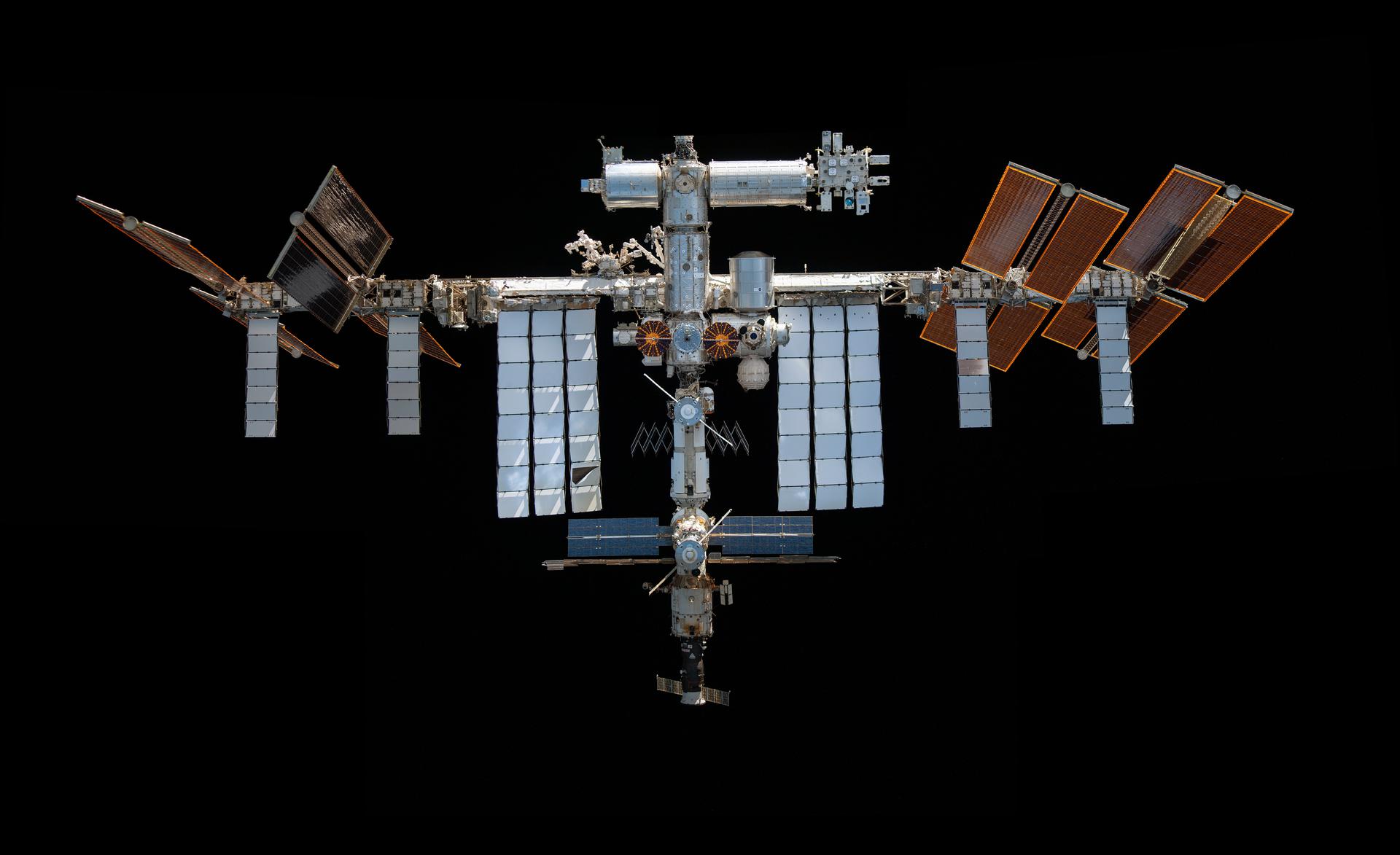
Massive radiators. In this photo[0], all of the light gray panels are thermal radiators. Note how they are nearly as large as the solar panels, which gives you an idea about the scale needed to radiate away 3-12 people's worth of heat (~1200 watts) + the heat generated by equipment.
The ISS has giant heat sinks[1]. Those heat sinks are necessary for just the modest heat generated on the ISS, and should give an idea of what a sattelite full of GPU's might require...
I liked one comment someone made: if it's just about dodging regulation, then put the data centers on container ships. At any given time, there are thousands of them sailing in international waters, and I'm sure their operators would love to gain that business.
That being said, space would be a good place to move heat around with Peltier elements. A lot of the criticisms revolve around the substantial amount of coolant plumbing that will be needed, but that may not necessarily be what SpaceX has in mind.
As far as I can tell, Data centres in space only seem viable because their advocates insist on comparing them to standard terrestrial data centres.
And nobody ever calls them out on it.
Data centres which are optimised for reliability, redundancy, density, repairability, connectivity and latency. Most of the savings come not from placing the data centre in space, but the fact that advocates have argued away the need for absolutely everything that modern data centres are designed to supply, except for the compute.
If they can really build a space data centre satellite for as cheap as they claim, why launch it? Just drive it out into the middle of the desert and dump it there. It can access the internet via starlink, and already has solar panels for power and radiators for cooling. IMO, If it can cool itself in direct sunlight in space, it can cool itself in the desert.
The main thing that space gains you over setting up the same satellite in the desert is ~23 hours of power, vs the ~12 hours of power on the ground. And you suddenly gain the ability to repair the satellite. The cost of the launch would have to be extremely cheap before the extra 11ish hours of runtime per day outweighed the cost of a launch; Just build twice as many "ground satellites".
And that's with a space optimised design. We can gain even more cost savings by designing proper distributed datacenter elements. You don't need lightweight materials, just use steel. You can get rid of the large radiators and become more reliant on air cooling. You can built each element bigger, because you don't have to fit the rocket dimensions. You could even add a wind turbine, so your daily runtime isn't dependant on daylight hours. Might even be worth getting rid of solar and optimising for wind power instead.
An actual ground optimised design should be able to deliver the same functionality as the space data centre, for much cheaper costs. And it's this ground optimised distributed design that space data centres should be compared to, not today's datacenter which are hyper-optimised for pre-AI use cases.
You don’t even need the desert. Just put it in India and use coal power or whatever. AI training doesn’t care about latency to the data centre, so you could put it anywhere, as long as it is cheap.
I mean, I'd prefer they used some form of renewable energy.
But there should be plenty of options once you start actually optimising for the same use-case as space data centres. Many places have very predictable wind (especially off-shore, which gives you bonus access to cooling water). Or maybe you could set up small hydro power schemes along remote rivers.
Elon has used the greater fool theory for so long that they no longer exist on earth. It makes perfect sense he would focus on space because if he does find aliens it'll be an entirely new investor pool for him, and he desperately needs that now.
I'm convinced that >30% of this comes from ideas leaking out of fiction such as like Neuromancer, and percolating through the minds of wealthy people attracted to some of the concepts. Namely, the dream of being a hyper-wealthy dynasty, above any earthly government, controlling an extraterritorial Las Vegas Fiefdom In Space. (Which in the book, also hosted a powerful AI.)
Then they work backwards, trying to figure out some economic engine to make it happen. "Data centers" are (A) in-vogue for investment right now and (B) vaguely plausible, at least compared to having a space-casino.
That's not fair! Sometimes the ideas come from Snow Crash, which gave us the Metaverse because Zuckerberg wanted to cut a guy in half with a katana from a motorcycle.
I’ve come to think of interviews with people like Sam Altman as “freestyle science fiction.” They’re just saying stuff off the top of their head. Like you say, that often entails vague ideas from other sci fi percolating up and out, with no consideration of if they actually make sense. And like most freestyle, it’s usually pretty bad.
That is possible because DOGE and their comrades gutted the SEC and indirectly FINRA like a fish. The government is run by confidence men running crypto scams.
That’s how the CFO of OpenAI can essentially say “we need a Federal bailout”, and then turn around and say “lol just joking”.
I mean definitely, and they're not shy about admitting it. They see cool stuff in imagination-land, think it's cool, and work to make it a reality. Many people have worked to make the fantastical things shown in Star Trek.
A lot more. Everyone is chasing scifi ideas, ridiculous. This shows that even people with high IQ lack fantasy/imagination and creativity. They are intelligent robots.
So whenever I see here or anywhere else that your ideas mean nothing I just laugh at it. Of course, these come from people who are bland, doesn't have any imagination and they are not creative at all at all, but they have brute force, which is money.
It seems like every argument in favor of doing this is: "yeah sure but what if X was Y% cheaper?"
And some of us are reading these things and trying to be polite.
But at some point patience runs thin and the only response that breaks through the irrationality is some variation of "what if unicorns and centaurs had teamed up with Sauron?"
The limit of the ratio of useful:useless "what if's" approaches zero.
Assuming that we place an iron ball (ideal sphere-shaped and thermal conductivity) on the SSO (solar synchronous orbit), how hot can the object be?
Given the solar constant 1361 W/m^2, you can calculate the temperature range based on the emissivity and absorptivity. With the right shape and “color”, the equilibrium temperature can be cooler than most people thought.
I suppose that a space data center powered 100% by solar is no different than this iron ball in principle.
Very confused by this plan. Data centers on Earth are struggling with how to get rid of waste heat. It's really, really hard to get rid of waste heat in space. That seems to be about the worst possible place to put a data center.
It’s a distraction as they suck out as much value from Tesla as possible before the music stops and they go bust. There are a few really big IPOs this year including SpaceX, which will likely trigger significant market volatility.
Indeed. I would go so far as to assert that, of all the ideas that have ever been proposed in the history of humanity, data centres in space is most certainly one of them.
Yeah he only micromanages (look at his old blog) every detail he has time for at an extremely successful aerospace engineering company, just an ideas guy.
> Yeah he only micromanages (look at his old blog) every detail he has time for at an extremely successful aerospace engineering company, just an ideas guy.
Have you ever spoken to someone who works at SpaceX? I have multiple friends in the industry, who have taken a trip through the company.
The overwhelming consensus is that - in meetings, you nod along and tell Elon "great idea". Immediately after you get back to real engineering and design things such that they make sense.
The folks working there are under no delusion that he has any business being involved in rocket science, it's fascinating that the general public doesn't see it that way.
Why are they doing any better than any other firm then? Why has Tesla been successful? Why is xAI pretty similar in terms of approach? My idea has less variables than yours. It also doesn't fly with his tendency to fire people.
Shedding the very slow process of “legacy” defense/aerospace companies, taking more risks, moving faster, accepting some setbacks etc does not mean you need to go full Musk. There is a middle ground.
What kind of the problem you're talking about compared to existing satellites? That is, all existing satellites generate power, and need to dissipate that power, and most of it goes to waste heat, and the satellites somehow do that successfully - what is the specific problem you're talking about, which can't be solved by the same means?
The numbers matter. The thermal budget a satellite is an tightly controlled thing. Large modern ones are in the order of a few to a couple of 10s of kilowatts, so something like a few to several low 10s of modern GPU compute power. Even with thousands of yet to be designed or launched satellites, it's going to have trouble competing with even a single current DC, plus it is in SAPCE for some reason, so everything is more expensive for lots of reasons.
> it's going to have trouble competing with even a single current DC
This looks like a valid argument to me, yes. Elon mentioned 1,000,000 satellites - I'm thinking about 3rd version of Starlink as a typical example, 2 tons, 60 satellites per Starship launch, 16,000 Starship launches for the constellation, comparing with 160 launches per year of today's Falcon 9...
The argument about problems of dissipating heat still stands - I don't see a valid counterargument here. Also "SAPCE" problem looks different from the point of view of this project - https://www.50dollarsat.info/ . Basically, out launch costs go way down, and quality of electronics and related tech today on Earth is high enough to work on LEO.
Even the buses for giant communications satellites are still at the single digit kilowatt scale. The current state of the art in AI datacenters is 500+ kw per rack.
So you're talking about an entirely different scale of power and needed cooling.
The reason we dont have a lot of compute in space, is because of the heat issue. We could have greater routing density on communication satellites, if we could dissipate more heat. If Starlink had solved this issue they would have like triple the capacity and could just drop everything back to the US (like their fans think they do) rather than trying to minimise the number of satellites traffic passes through before exiting back to a ground station usually in the same country as the source. In fact, conspiratorially, I think thats the problem he wants to solve. Because wet dreams of an unhindered, unregulated, space internet are completely unanswered in the engineering of Starlink.
I have actually argued this from the other side, and I reckon space data centres are sort of feasible in a thought experimental sense. I think its a solvable problem eventually. But heat is the major limiting factor and back of the napkin math stinks tbh.
IIRC the size/weight of the satellite is going to get geometrically larger as you increase the compute size due to the size of the required cooling system. Then we get into a big argument about how you bring the heat from the component to the cooling system. I think oil, but its heavy again, and several space engineering types want to slap me in the face for suggesting it. Some rube goldberg copper heatpipe network through atmosphere system seems to be preferred.
I feel like, best case, its a Tesla situation, he clears the legislative roadblocks and solves some critical engineering problem by throwing money at it, and then other, better people step in to actually do it. Also triple the time he says it will take to solve the problem.
And then, ultimately, as parts fail theres diminishing returns on the satellite. And you dont even get to take the old hardware to the secondary market, it gets dropped in the ocean or burnt up on reentry.
Principally speaking, as much energy as satellite receives from solar panels it needs to send away - and often a lot of it is in the form of heat. So, the question is, how much energy is received in the first place. We currently have some quarter of megawatt of solar panels of ISS, so in principal - in principal - we know how to do this kind of scale per satellite. In practice we perhaps will have more smaller satellites which together aggregate the compute to the necessary lever and power to the corresponding level.
The ISS's radiators weigh thousands of kilograms to radiate around 70 KW. He's talking about building data centers in space in the GW range.
Assuming he built this in LEO (which doesn't make sense because of atmospheric drag), and the highest estimates for what starship could one day deliver to LEO (200 metric tons), and only 1 metric ton of radiators per 100KW, that's 50 launches just to carry up the radiators.
Well the issue is that a lot of people believe that space is cold. If you will ask Google/Gemini what is a temperature of space, it will tell you:
The average temperature of deep space is approximately -270.45°C or 2.73 Kelvin), which is just above absolute zero. This baseline temperature is set by the Cosmic Microwave Background (CMB) radiatio...
Which is absolute nonsense, because vacuum has no temperature.
It has nothing to do with the movements of atoms, but just with the spectrum of photons moving through it. It means that eventually, any object left in space will reach that temperature. But it will not necessarily do it quickly, which is what you need if you're trying to cool something that is emitting heat.
That's not how it works. Two bodies are in thermal equilibrium if there's no heat transfer between them: that's the zeroth law of thermodynamics. If you're colder than 2.73K in deep space, you will absorb the heat from the Cosmic Microwave Background. If you're hotter, you will irradiate heat away. So it does have a temperature.
Well it isn't a perfect vacuum and it does have a temperature. But temperature is only a part of the story, just like how you go hypothermic a lot faster in 50 degree water than in 50 degree air.
but if you did use thermometer in space it would eventual read 2.73 kelvin right? so whats the issue? and also for a space based server it would have to deal with the energy coming from the sun
You guys clearly didn't read the full blog post where Musk mentions lunar mining. They're going to put an ASML machine on the moon and turns regolith into chips and solar panels automatically. Literally free compute
You could have said the same thing about Europe or America. We could have just stayed in Africa, and the people like you did. But taking the leap worked pretty well, even if it was tough at the beginning.
As a thought experiment, if humanity wanted to go all in on trying to move industrial processes and data centers off planet, would it make more sense to do so on the moon?
The moon has:
- Some water
- Some materials that can be used to manufacture crude things (like heat sinks?)
- a ton of area to brute force the heat sink problem
- a surface to burry the data centers under to solve the radiation problem
- close enough to earth that remote controlled semi-automated robots work
I think this would only work if some powerful entity wanted to commit to a hyper-scale effort.
it could be easier just to build in orbit. its a lot closer, sites can be positioned above various geographic locations as required.
i think the moon likely does contain vast mineral deposits though. when europeans first started exploring australia they found mineral anomalies that havent existed in europe since the bronze age.
the Pilbara mining region is very cool. it contains something like 25% of the iron ore on earth, and it is mostly mined using 100% remote controlled robots and a custom built 1000 mile rail network that runs 200-300 wagon trains, mostly fully automated. it is the closest thing to factorio in real life. 760,100 tonnes a year of iron ore mined out and shipped to China.
Water on the moon is limited and difficult to collect, it wouldn't make sense to use it for industrial purposes. It's a very challenging thermal environment (baking during the day, freezing at night). But perhaps worst of all, every month there's a 14-day period with no solar power. Overall seems worse than low-earth orbit.
The elephant in the room for all lunar scenarios is lunar regolith. Even ignoring the toxicity to humans (big problem and will happen quite quickly for any humans there!), it will be a big long-term problem for robots and machinery in general.
Probably a lot easier, but the moon looses a major selling point of data centres in space, namely reasonable latency. To be clear, I don't think it's a good idea. But I think that specifically the way Musk is trying to position it, the moon would be an even harder sell.
What if instead we moved it all to a closer rock that has even more water, even more materials to manufacture crude (and even advanced) things, even more surface, more protection from radiation, and even crazier still had significantly less launch costs?
Almost any reason why the moon is better than in orbit is a point for putting it on earth.
I think there's something to be said about imagining a future where we can keep the earth clean of all the nasty industrial processes we have grown accustomed to living next to. A big part about this proposed idea is that you could do a lot of manufactoring in space.
I have long theorized there will be some game changing manufacturing processes that can only be done in a zero gravity environment. EX:
- 3d printing human organ replacements to solve the organ donor problem
- stronger materials
- 3d computer chips
I do not work in material science, so these crude ideas are just that, but the important part I'm getting at is that we can make things in space without any launches once that industry is bootstrapped.
We're able to make 3D computer chips on Earth today, and I don't know about you but all my organs managed to get made just fine on Earth. Doesn't seem like we need zero g to do either of these things.
Either way, this isn't about 3D printing organs, this is about launching AI compute into space. To do important stuff, like making AI generated CSAM without worry of government intervention.
One way to work around the heat dissipation issues in space (and also on earth) is to move to computing systems that operate entirely at cryogenic temperatures to take advantage of superconducting circuitry.
I've heard stories that over a decade ago teams inside hyperscalars had calculated that running completely cryogenically cooled data centers would be vastly cheaper than what we do now due to savings on resistive losses and the cost of eliminating waste heat. You don't have to get rid of heat that you don't generate in the first place.
The issue is that at the moment there are very few IC components and processes that have been engineered to run at cryogenic temperatures. Replicating the entirety of the existing data center stack for cryogenic temps is nowhere near reality.
That said, once you have cryogenic superconducting integrated circuits you could colocate your data centers and your propellant/oxidizer depots. Not exactly "data centers off in deep space" since propoxd tend to be the highest traffic areas.
Google, Spacex, several startups are all doing this. The best people in their fields think it might be viable. I'm skeptical as well, but you do wonder if maybe they are right and how exciting that would be.
They're gonna propose something dumb like ejecting coolant out into space as a disposable heatsink and then they're gonna spend a bunch of money trying to build a proof-of-concept but it will never go anywhere because it's really some kinda money laundering scheme or whatever the Hyperloop nonsense was.
AI data-centers use upwards of 100MW. The biggest solar panels in space could produce around 240KW. When they speak of AI data-centers in space what do they actually mean in realistic non theoretical terms and where are the materials for this coming from?
If the AI data-center used only 10MW then each could have two redundant SMR's assuming the cooling challenges have been worked out but then we could have nuclear reactor disposal and collision issues.
The only thing that keeps bouncing around in my thick skull is something "data-center sized" whatever that means to them could hold some interesting objects. 2 Peta Watt laser, Rods from God, Tactical nukes, Miniature Rail-gun to quickly eradicate other satellites, Off-Planet archives of stuff, Doomsday clusters of brainwave transmitters to shut off all the humans or force everyone to defecate at once.
Those are just some guesses. Some of those could also explain the "why" for SpaceX Falcon Heavy and it's future iterations. It can carry 63,800 kg (140,660 lbs) to Low Earth Orbit and that load capacity will only increase with future versions.
I assume the idea is to have the entire constellation be the data center in question. Laser back haul transceiver bandwidth is in the same order of magnitude of rack-to-rack bandwidths [1][2]. I could see each sat being a rack and the entire mesh being a cluster.
This is how Starlink works however, you would need orders of magnitude more compute than those router pucks. Orders of magnitude more power needs unless you combined a nuclear reactor to it. It’s just such a fever dream at this stage that he’s really doing it to muddy accounting and consolidate debts from Grok failures.
> Data centers in space only make sense if they are cost effective relative to normal data centers.
Author made a fatal mistake. By flying enough hardware in space, you can simply blot out the sun and steal their solar capacity. Drink their milkshake with a long straw!
I bet they can already weaponize their satellites to prevent the launch of other satellites.
Putting data centers in space keeps them out of reach of humans with crowbars and hammers, which may have been a vulnerability for those robots Tesla is building.
How about we just make a giant heatsink that reaches into space instead. Then we can cool the whole planet. Coming up with crazy ideas is cheap, but the logistics are obviously impractical.
> Our core innovation is a radiative cooling material that we’ve combined with a panel system to improve the efficiency of any vapor-compression based cooling system
A heat pump is a “ vapor-compression based cooling system” so that tech is an addition-to not an instead-of.
Whether it’s better probably depends on how expensive the additional efficiency is in practice.
> SkyCool’s Panels save 2x – 3x as much energy as a solar panel generates given the same area.
It possibly makes sense if you're preparing for war, harder to hit, harder to physically break into, beyond the range of nuclear EMP, and accessible from anywhere on earth.
Any country capable of producing nuclear warheads will also be able to toss up enough BBs and other small objects into LEO to wipe out most of Starlink and anything else in LEO. At least on Earth data centers in theory can be hidden and physically hardened. In orbit, even a crude rocket able to reach that plane can become a weapon of mass satellite destruction. Even if those orbits clear out in four or five years, by then whatever ugliness is going on down on the surface of Earth will likely have resolved one way or the other. Starlink is a great military asset for a superpower pushing around smaller states in ways that aren't an existential threat to them. In a real conflict, it's a fragile target beyond the strike capacities of much of the developing world but easily destroyed by any moderate level industrial nation.
Any country capable of producing nuclear warheads will also be able to toss up enough BBs and other small objects into LEO to wipe out most of Starlink and anything else in LEO.
Pakistan doesn't have a domestic orbital launch capability but it does have nuclear weapons.
Surprisingly, the United Kingdom doesn't have a domestic orbital launch capability at present though it has had ballistic missiles and nuclear weapons for many decades.
At present, I would say that building a basic implosion-assembled atomic bomb is easier than building a rocket system that reach low Earth orbit. It's a lot easier to build a bomb now than it was in the 1940s. The main thing that prevents wider nuclear weapon proliferation is treaties and inspections, not inherent technical difficulties.
Satellites. Are. Fragile. People really don’t seem to intuitively understand this. Earth based assets are orders of magnitude more difficult to attack simply by virtue of being able to be placed inside of fortified structures anchored to, or inside of, the ground. The cost to deploy hardened buildings at scale is peanuts compared to orbiting constellations.
They also fail to realize how devastating an attack a BB canister grenade would be in LEO. Nothing would stay in orbit. Eventually everything would collide and come down.
You don't need EMP for that. Few ASAT missiles will start the avalanche and turn orbits around Earth into shooting range. Good luck talking to your satellites with shredded antennas and solar panels.
And what about servicing? Last I checked these data centers don't run without incident and need people (or fine robots) to physically interact with them.
To Steelman the topic, Musk’s whole alleged mission is to make humans a multi-planet species that can survive an earth killing event.
To that end, a small data center space isn’t about unit-economics, it’s a bigger mission. So the question we should consider is what can we put into space the further that mission. Can we put a meaningful sum of human knowledge out there for preservation? It sounds like “yes,” even if we can’t train ChatGPT models out there yet.
When I was a kid, I had to go to CCD, a religious after school program for Catholics.
The whole time I was there it was a mental game of trying to steel man the contradictory or incoherent stuff, using my brain power to try and rewrite things to make sense.
After some years, I woke up and realized that’s what I was doing, and even if I could do it in my mind, that didn’t make the source material rational.
I do not politically align with Musk. I’ve always thought Tesla was important in popularizing electric cars while being a low-quality built product with repair and supply chain issues. I think The Boring Company is a joke. Twitter was a power-grab.
I also think SpaceX is societally beneficial, a good means to shake-up a stagnant industry and a humanity-wide area of interest.
If you think I’m a member of a religious cult, I respectfully suggest you evaluate what led
You to believe that itself.
The problem of datacenters in space and knowledge preservation/disaster redundancy are entirely disjoint.
Datacenters in space have a lifespan measured in years. Single-digit years. Communicating with such an installation requires relatively advanced technology. In an extinction level crisis, there will be extremely little chance of finding someone with the equipment, expertise, and power to download bulk data. And don't forget that you have less than a decade to access this data before the constellation either fails or deorbits.
Meanwhile people who actually care about preserving knowledge in a doomsday crisis have created film reels containing a dump of GitHub and enough preamble that civilizations in the far future can reconstruct an x86 machine from scratch. These are buried under glaciers on earth.
We've also launched (something like) a microfilm dump of knowledge to the moon which can be recovered and read manually any time within the next several hundred or thousand years.
Datacenters in space don't solve any of the problems posed because they simply will not last long enough.
Let's say there is an earth killing event, and let's say there is an outpost on Mars with some people on it. How much does it really matter that some humans survive, in light of the enormous catastrohophe that killed all life on earth? Is it a very worthwhile objective for our species to persist a while longer, or should we not just accept that also life itself will will die out on geological or astronomical time scales?
I would suppose there is a gap we face between true species-wide survival capability and where we sit today. I have no true idea how hard we must go to bridge that gap, but it’s quite hard and far.
I also see no reason to “lay down and die” as I feel is somewhat implied here. I think it’s a truly noble cause, but maybe I read too much sci-fi as a young lad.
No matter what anyone does, the universe will end, and reality will stop changing.
Everything dies. Deal with it.
Instead of empowering shithead grifters who promise you a way out, grow trees to create shade for people you will never know. You do that by improving things, not burning limited resources on a conman.
I’m not the right type of engineer to know and, hell, software largely isn’t engineering anyway…
Can you not provide any type of shielding at scale to wrap a (small, not Google tier) data center? To be honest my criticism with TFA is its focus on “you can’t do massive scale” rather than the premise entirely.
Yes, but the added mass makes it prohibitively expensive. Shielding is heavy and every kilogram of added payload results in a geometric increase in fuel load.
The rocket equation will kick your ass every time.
Musk's whole mission is to scam even more people. Unfortunately people still buy his bullshit even though he couldn't deliver on anything, and just converts one failure to hyping up his next idiotic product.
He's going to do a DOGE (memecoin not government agency) equivalent over phones new satellite links to his SpaceX sats outside anyone national jurisdiction. Worth the possibility of taking over being the world's global currency unconnected from any/all government.
A thought experiment. Imagine that you had some magic way of getting all the electricity you wanted at the south pole, you had good internet connectivity, and the various treaties about the place weren't an issue for you. Would you want to build a data center there?
Seems like a pretty obvious "no" to me. Loudoun County is a much better choice, just to pick one alternative. Antarctica is an awfully inhospitable place and running a data center there would be a nightmare.
And yet it's way better than space. It's much easier to get to. Cooling is about a thousand times easier. The radiation environment is much more forgiving.
This whole concept is baffling to me.
(Incidentally, a similar thought experiment is useful when talking about colonizing Mars. Think about colonizing the south pole. Mars is a harsher environment in just about every way, so take the difficulties of colonizing the south pole and multiply them.)
It doesn't make any sense to me either, but there are lots of things like that where the other thing is harder. As an example, a thing people say online a lot is something like "Why do the techbros build self-driving cars instead of just putting it on rails for efficiency and then they could call it a TRAIN?"
The answer to that is that coordination problems are really hard. Much harder even than what are currently unsolved engineering problems. In fact, SpaceX can only launch from California because they have DOD coverage for their launches. Otherwise the California Coastal Commission et al. would have blocked them entirely. Perhaps the innovation for affordable space Internet is combining it with mixed-use technology.
The truth is that in America today self-driving cars (regulated by a state board run by bureaucrats) are easier to build than trains (regulated by every property owner on the train route). Mark Zuckerberg tried to spend some money evaluating a train across the Bay and had to give up. But Robotaxi service is live in San Francisco.
So if there is an angle that makes sense to me it's that they anticipate engineering challenges beatable in a way where regulatory challenges are not.
Interesting insight. I can think of some objections, but they don't change your point.
I also checked out your blog and got 2 interesting articles in 2 tries. If you have some personal favourites and listing them is not a bother, I'd be happy to read them.
That's awfully kind of you to say! I added a section to the Main Page listing a couple of ones that people have mentioned to me before, though it's a bit of a cluttered page so I doubt it works as it stands.
A few things I think of more frequently than they affect my life are:
The bigger issue: datacenters in space are disposable. All the extremely recyclable aluminum, silica - you extract it, manufacture it and instead of recycling it when it’s done you incinerate it in the atmosphere and scatter the ashes far and wide across the earth, the harder to recapture later.
You do this when the most fragile part in the system fails. Solar panels good for 25 years but the SSDs burn out after 2? Incinerate the lot!
This kind of thinking is late capitalist brain rot. This kind of waste should be a crime.
Is there any insight into how Starlink solved cooling? One 'expert' insisted that there is no reason to expect that data center satellites would generate any more heat than starlinks.
I'm not sure datacenters in space have to make suense to everyone, or from the perspective of earth.
Taking a creative step back, perhaps datacenters in space support something with Mars?
As much as that might not seem realistic, I also have to counterbalance it with operationalizing and commercializing SpaceX, Starlink and Tesla relatively quickly when so much stays at the R&D stage for so long.
I am willing to bet the whole xAI/SpaceX merger is simply a ploy by Musk to evade releasing accurate historical information about SpaceX's finances. How much did it actually cost SpaceX to launch a kilogram of payload into space each year? How much is NASA actually donating them, per each year?
I mean, I still remember promises of $1000-per-kg for space launches, and how e.g. Gigafactory will produce half of the world battery supply, and other non-scientific fiction peddled by Musk. Remember when SpaceX suggested in 2019 that the US Army could use its Starship rockets to transport troops and supplies across the planet in minutes? I do. By the way, have they finished testing Starship yet, is it ready?
This is written by someone that is not in aerospace that thinks terrestrially.
Engineering is always a question of tradeoffs.
Launch costs are dropping, and we’re still using inefficient rockets. Space elevators & space trains, among others, can drop this much more, the launch costs are still dropping, even using rockets, maybe we’ll never get to elevators & trains the costs will drop so low!
Radiation shielding is not required for VLEO or LEO, and phenomenally more capable aerospace processors are near - hi Microchip Inc! There are many other radiation solutions coming, no doubt with nuclear power.
Satellites can be upgraded at scale, though for many things, it does not make $ sense to upgrade them, but fuel , reaction wheels, solar panels, among other things do make $ sense to replace.
Latency was technically solved in 1995 & 2001 with the first laser comms missions NASDA’s ETS-VI kiku-6 and ESA’s Artemis , and Laser crossbars for comms are common. A full laser TDRS no RF is not yet extant but soon. Earth to deepspace was just demonstrated by ESA.
Cooling can be significantly improved due to lower launch costs, heat piping, RTGs, TEGs, and thermoradiative cells, not to mention sunside solar and darkside inline radiators
Furthermore, it is very likely that as neuromorphics with superior SWaP emerge, we could see very different models of space based computation.
Economic tradeoffs should drive many of these decisions as I’m not discussing the other applications of datacenter in space
> Cooling can be significantly improved due to lower launch costs, heat piping, RTGs, TEGs, and thermoradiative cells, not to mention sunside solar and darkside inline radiators
You're saying they're going to steal the night? We'll see the sun in the day, radiative cooling for surveillance AI in the time formerly known as night?
I'll confess that the numbers aren't nearly as bad as I'd thought. Apparently, you can dissipate 1MW at 100°C with a 17m diameter sphere at night. So it's like the size of a small house. It doesn't even glow. On the other hand, you need a lot of temperature differential to move the heat out fast enough, which means your TPUs are going to be hellishly hot.
Though you'd probably only run it when it's in the sun and radiate in other directions, so you don't have to store the power in heavy batteries. You need a 56m diameter disk of solar panels to provide 1MW, don't forget that.
(All figures were vibe calculated with Claude and are unchecked.)
No no, let Musk cook. This definitely won't be SpaceX's Cybertruck moment, where they completely throw away their first-mover advantage by wasting five years chasing after the egotistical boondoggle of a delusional megalomaniac.
- Data centres need a lot of power = giant vast solar panels
- Data centres need a lot of cooling. That's some almighty heatsinks you're going need
- They will need to be radiation-hardened to avoid memory corruption = even more mass
- The hardware will be redundant in like 2 years tops and will need replacing to stay competitive
- Data centres are about 100x bigger (not including solar panels and heat sinks) than the biggest thing we've ever put in space
Tesla is losing market share (and rank increasingly poorly against alternatives), his robots are gonna fail, this datacentre ambition needs to break the laws of physics, grok/twitter is a fake news pedo-loving cesspit that's gonna be regulated into oblivion. Its only down from here on out.
Maybe instead of housing life, civilizations develop Dyson's spheres to house data centers. Solar panels on the interior, thermal radiators on the exterior and the data centers make up the structure in between. Combine that Von Neumann probes and you've got a fun new Fermi paradox hypothesis!
Don't combine it with von Neumann probes and you've solved the Fermi paradox: a civilization that puts that much work into computing power is either doing the equivalent of mining crypto and going nowhere, or is doing AI and is so dependent on it that they inevitably form a vast echo chamber (echo sphere?) that only wants to talk to itself (itselves?) and can't bear to be left out by adding the latency unavoidably added by distance.
tl;dr: civilizations advanced enough to travel between stars end up trapped by the resources and physics required to keep up with the Joneses.
There are two very distinct kinds of AI workloads that go into data centres:
    1. Inference
    2. Training
Inference just might be doable in space because it is "embarrassingly parallel" and can be deployed as a swarm of thousands of satellites, each carrying the equivalent of a single compute node with 8x GPUs. The inputs and outputs are just text, which is low bandwidth. The model parameters only need to be uploaded a few times a year, if that. Not much storage is required , just a bit of flash for the model, caching, logging, and the like. This is very similar to a Starlink satellites, just with bigger solar panels and some additional radiative cooling. Realistically, a spacecraft like this would use inference-optimised chips, not power-hungry general purpose NVIDIA GPUs, LPDDR5 instead of HBM, etc...
Training is a whole other ballgame. It is parallelisable, sure, but only through heroic efforts involving fantastically expensive network switches with petabits of aggregated bandwidth. It also needs more general-purpose GPUs, access to petabytes of data, etc. The name of the game here is to bring a hundred thousand or more GPUs into close proximity and connect them with a terabit or more per GPU to exchange data. This cannot be put into orbit with any near-future technologies! It would be a giant satellite with square kilometers of solar and cooling panels. It would certainly get hit sooner or later by space debris, not to mention the hazard it poses to other satellites.
The problem with putting inference-only into space is that training still needs to go somewhere, and current AI data centres are pulling double-duty: they're usable for both training and inference, or any mix of the two. The greatest challenge is that a training bleeding edge model needs the biggest possible clusters (approaching a million GPUs!) in one place, and that is the problem -- few places in the world can provide the ~gigawatt of power to light up something that big. Again, the problem here is that training workloads can't be spread out.
Space solves the "wrong" problem! We can distribute inference to thousands of datacentre locations here on Earth, each needs just hundreds of kilowatts. That's no problem.
It's the giaaaant clusters everyone is trying to build that are the problem.
I'd be curious to know simply how large the thermal radiator necessary to keep a typical GPU server cooled would be. Do they completely dwarf the server size? Can you do something with some esoteric material that is not particularly load-bearing but holds up well in space to get around some of these challenges?
Data centers in space make absolute sense when you want as close to real time analysis on all sorts of information. Would you rather have it make the round trip, via satellite to the states? Or are you going to build these things on the ground near a battlefield?
Musk is selling a vision for a MASSIVE government contract to provide a service that no one else could hope to achieve. This is one of those projects where he can run up the budget and operating costs like Boeing, Northrup etc, because it has massive military applications.
I can assure this author: strapping a company that lights money on fire (today, maybe not tomorrow) to a cash flow enterprise makes the IPO harder, not easier, in the absence of credible plan. The market speculates, but it’s not being completely irrational. I’d actually be surprised if we didn’t have factories or data centers in space one day.
Data centers in space are the logical progression from the multi trillion business of m2m and edge computing. It removes all physical limits to investment.
That post does not appear to address or acknowledge any of these problems: 1) thermal management in space, 2) radiation degrading the onboard silicon, 3) you can’t upgrade data centers in orbit
*Data centers in space only make sense if they are cost effective relative to normal data centers*.
Disagree there are bunch of scenarios where Data Centers in space make sense. Like nuclear annihilation and having vaults across the globe to communicate and get back lost information because ground data centers would be wiped out by EMP from blasts.
Has it occurred to anyone that you can put computers underground? In this apocalyptic scenario you are describing, how do you expect the ground based command and control infrastructure to survive? Satellites are 100% reliant on ground based operations. That is a hard requirement. And if you put the command and control underground, might as well just skip the whole space based plan and just put the data underground.
It was not my intention to single you out, my apologies.
There is nothing wrong to imagine anything you like. But if you do it as a CEO, i personally consider that as fraud. Guess I'm weird and old-fashioned like that.
Space offers some unique benefits that enable computing that’s impossible or very hard to do on earth. E.g. Super conducting computing is possible, which can be thousands times to millions times faster than current CPU while using very little energy. When the satellite moves in the shade of the earth, temperature drops significantly. It can be low enough to enable superconducting. When the satellite moves under the sun, the solar panel can start charging up the battery to power the ongoing operation.
i don't understand? you won't insulate the craft from the sun? and you expect the craft to get rid of its heat just from being behind the earth for a moment?
What’s there not to like? Superconductors. Free electricity. No cooling necessary.
Put those three together and maybe it’s possible to push physics to its limits. Faster networking, maybe 4x-5x capacity per unit compared to earth. Servicing is a pain, might be cheaper to just replace the hardware when a node goes bad.
But it mainly makes sense to those who have the capability and can do it cheaply (compared to the rest). There’s only one company that I can think of and that is SpaceX. They are closing in on (or passed) 8,000 satellites. Vertical integration means their cost-base will always be less than any competitor.
No, just you. Superconductors don’t get hot. There is 0 resistance in superconducting mediums. Theoretically you could manufacture a lot of the electricity conducting medium out of a superconductor. Even the cheapest kind will superconduct in space (because it’s so cold).
Radiation may be sufficient for the little heat that does get produced.
Right. You build your computers out of superconductors, and they don't get hot.
Sadly, they also don't compute.
> Even the cheapest kind will superconduct in space (because it’s so cold).
Is this a drinking game? Take a drink whenever someone claims that heat is not a problem because space is cold? Because I'm going to have alcohol poisoning soon.
Let's see how cold you feel when you leave the Earth's shadow and the sun hits you.
Do you mean to suggest that computer hardware does not need to be cooled when it is in space? Or that it is trivial and easier to do this in space compared to on Earth? I don’t understand either claim, if so.
Even assuming that this la-la-land idea has merit, the equilibrium temperature at the Earth's orbit is 250 Kelvin (around -20C). The space around the Earth is _hot_.
There are people literally working on accomplishing this. I don’t understand what’s with the arrogance and skepticism.
Edit: Not trying to single out the above commenter, just the general “air” around this in all the comments.
I honestly believed folks on HN are generally more open minded. There’s a trillion dollar merger happening the sole basis of which is the topic of this article. One of those companies put 6-8,000 satellites to space on its own dime.
It’s not a stretch, had they put 5 GPUs in each of those satellites, they would have had a 40,000 GPU datacenter in space.
> There are people literally working on accomplishing this.
They're reinventing physics? Wow! I guess they'll just use Grok AI to fake the launch videos. Should be good enough for the MVP.
For the superconductivity idea to work, the entire datacenter needs to be shielded both from sunlight and earthlight. This means a GINORMOUS sun shield to provide the required shadow. But wait, the datacenter will orbit the Earth, so it also will need to rotate constantly to keep itself in the shadow! Good luck with station-keeping.
There's a reason the Webb Telescope (which is kept at a balmy 50K) had to be moved to a Sun-Earth Lagrange point. Or why previous infrared telescopes used slowly evaporating liquid helium for cooling.
> I don’t understand what’s with the arrogance and skepticism.
Because it's a fundamentally stupid idea. Stupid ideas should be laughed out.
I'm not talking about "stupid because it's hard to do" but "stupid because of fundamental physical limitations".